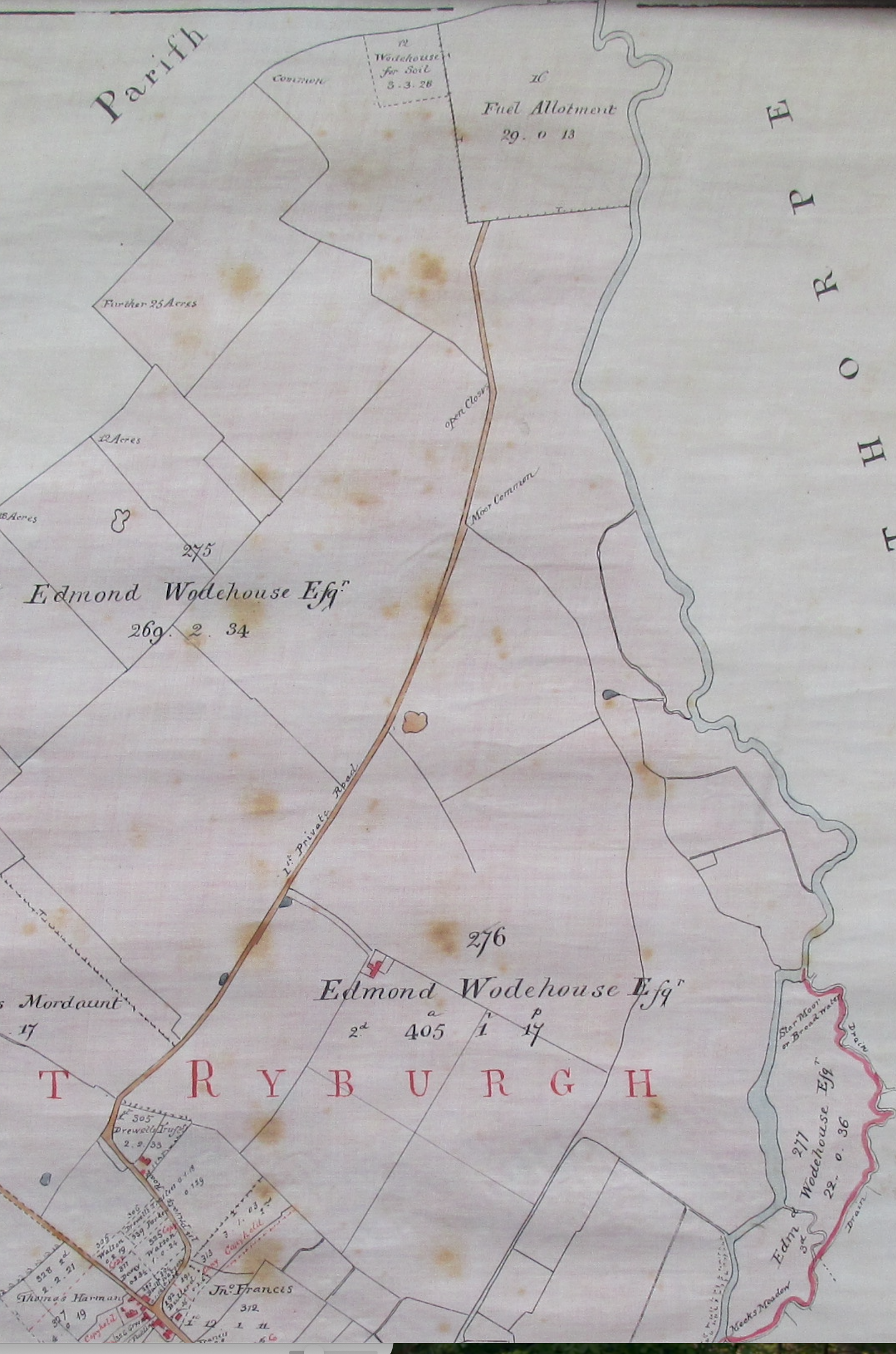
In the several surviving copies of the full and individual parish settlements, we find the details of the Award made in 1810:
Allotment for Fuel in Great Ryburgh
And we the said commissioners to hereby assign set out and allot unto the said Edmund Woodhouse, as Lord of the said Manor of Great Ryburgh, and Overseers in Great Ryburgh, to the said Charles Mordaunt, as Rector of the Rectory and Parish Church of Great Ryburgh, aforesaid, and to the Churchwardens and Overseers of the poor of the said, Parish of Great Ryburgh Trustees for the poor of the same parish One piece of land within the said parish of Great Ryburgh containing by measure 29 acres and 13 perches marked on the last mentioned, map or plan with the number 16, and bounded by the river Wensum towards the north in part towards the west by land hereby allotted to the said Edmond Woodhouse, and the first described private road in the said, parish of Great Ryburgh towards the east, by land hereby allotted to the said Edmond Woodhouse towards the south, and by the said parish of Testerton on the remaining part of the west. And we do here by certify and declare that we have made or given directions for making fences in the last mentioned allotment against the private road and against the allotments to the said Edmond Woodhouse And we do order and direct after the last mentioned, allotment shall have been so enclosed and fenced out as aforesaid the said fences shall at all times hereafter be maintained, kept in repair by the said trustees for the poor of the said Parish of Great Ryburgh for the time being.
This settlement was made after the passing of the specific Act of Parliament of 1808 that was drawn up for the Inclosure of the lands in the Parishes of Fulmodeston with Croxton, Stibbard, Little Ryburgh, and Great Ryburgh, The Act which you can read in full here specifies everything at length!
“and the same or any Part or Parts thereof shall be ploughed and sown with Whin or Furze Seeds at such Time or Times as the said Commissioners shall by Writing under their Hands or in and by their said Award order and direct, and the Flags, Turves or Turf, Whins or Furze coming, growing, and arising upon and from such Lands and Grounds as shall be so allotted for Fuel as aforesaid shall be cut, taken, and used by such poor Inhabitants legally settled in the said respective Parishes of Fulmodeston with Croxton, Stibbard, Little Ryburgh, and Great Ryburgh, and any or either of them, as the Case may be, in such Quantities, in such Manner, at such Time or Times in each and every Year, and under and subiect to such Rules. Orders, and Regulations as the said Trustees in and for the said Parishes respectively for the Time being or the major Part of them shall from Time to Time direct and appoint, and not other-wise; and it shall and may be lawful for the said Trustees or the major Part of them for the Time being in and for the said Parishes respectively to hold, use, and manage, or otherwise, by Writing under their Hands, to let and demise the said respective Allotment or Allotments or any Part or Parts thereof to any Person or Persons whom-soever from Year to Year, or for any Term of Years not exceeding Twenty-one Years in Possession, and not in Reversion or by way of future Interest, for the best and most improved yearly Rent or Rents which can reasonably be had for the same, and under such Stipulations and restrictions as to the ploughing, sowing, tilling, cropping and using the same as to the said Trustees or the major Part of them shall seem meet, and the Rents, Issues, and Profits thereof shall be from Time to Time taken and received by the said Trustees, or the major Part of them for the Time being, and applied and disposed of by them in the Purchase of Coals or other Articles for Fuel, which shall be given and distributed unto and amongst such poor Inhabitants legally settled in the said respective Parishes of Fulmodeston with Croxton, Stibbard, Little Ryburgh, and Great Ryburgh (as the Case may be) at such Times and in such Proportions….”
As Charitable Trusts become more regulated during the 19th Century we can look up Charity Commissioners’ reports for some corroborating detail:
Report of the Commissioners for Inquiring Concerning Charities
(In the County of Norfolk)
pps.658 /659
Parish of Great Ryburgh
Fuel allotment
“Under the Inclosure act for the parishes of Fulmodeston and Great and Little Ryburgh. (See Parish of Fulmodeston) the commissioners by their award bearing date 2nd November 1810, set out 29 acres and 13 perches for fuel for the poor of this parish.
On this land all the poor are allowed to cut fuel and the herbage is let for £9.05/- which is expended annually by the parish officers in cutting and carting turf for those who are incapable of cutting themselves each of whom is supplied with about two wagonloads"
It fell to the Church Vestry who were the seat of village governance to administer, along with the Fuel Allotment Trustees, this charitable facility for the benefit of the less well off parishioners. It is very sadly the case that the Vestry Minute Book covering the period from Inclosure to 1890 has since been lost. A new volume was started when the Revd. Henry Fowler Baker became Rector in 1890 following the disastrous tenure of Morris Joseph Fuller when the “peace and quiet” of the village was at an all time low.
With no earlier Vestry record to call upon we have to assume that HFB had on his arrival seen from the previous volume that he had inherited a situation of strife and confusion within the village and he writes to the Charity Commissioners for some clarity, receiving this reply:
From the Charity Commision to Rev. Henry Fowler Baker.
29 November 1890
Norfolk
Great Ryburgh
Fuel allotment
Rev. Sir
Referring to your letter of the 7th inst., I am to state that and an award made pursuant to an act for allotting lands in the parishes of Fulmodeston with Croxton and Stibbard, Little Ryburgh and Great Ryburgh in the county of Norfolk {48 Geo lll) an allotment containing 29 acres and 13 perches was awarded to the Lords of the Manor and the Rector ,churchwardens and overseers of the parish for fuel for the poor .The act in question authorises the Trustees to let the allottment for
any term not exceeding 21 years, and for the best rent obtainable, and apply the rents in purchasing fuel to be distributed amongst the poor inhabitants, legally settled in the parish at such times, and in such proportion, manner and form as the trustees may direct.
You may be able to obtain in the locality an extract from the award and act above referred to which are usually deposited with the Clerk of the Peace, but if desired an extract from the act, a copy of which is in this office can be supplied to you on payment of the stationers charge for transcription.
With reference to your further letter of the 18th. Instant I am not able to find that the Commissioners gave in 1868 any general authority to the trustees of this charity in regard to the mode of letting the lands, or the terms of tenancy and I am to request you to furnish a precise reference to any document or communication to which you may be referring.
I am to remind you that the accounts of this charity have not been rendered to this office as required by the law for several past years and I am to request that the accounts for the three past years may be prepared and forwarded as soon as practicable.
Some forms of account are enclosed together with a printed statement of the law on the subject.
I am Rev. Sir,
Your obedient Servant
G.H .Gauntlitt
This summary is in the handwriting of Henry Fowler Baker, Rector with no date but probably made fin 1890 for his benefit in trying to sort out the different view points of the parish
Found in the N.R.O. Great Ryburgh Parish Documents ref-PD 621/ 68
Allotment act of, 1808 summary
The authority given by the charity commissioners in 1868 to the trustees, i.e. Rector churchwardens, and overseers to let to the best advantage and expend the money in coals to the poor of Ryburgh, who have obtained a legal settlement. The power was vested in them to let the common with all rights and privileges. And on these terms, it was let to Philip Dodd in 1871. The following cases for trespass have been tried.
1st 1875, Binney v. M & R Howe
At the trial. Mr M Mesney produced the Vestry book showing that the land was publicly let at a Vestry March 22 1871 for £17 p an but the poor had not been forbidden to cut “whins”, but Defendants and others thought they had a perfect right to go & do as they pleased - the chairman pointed out the folly of this, and finally Defendants were dismissed with a caution on promising not to trespass again.
2nd. Penn v. Jno Utting -for shooting a pheasant, Mr Smith produced the parish book, showing that the land was let to Mr Dodd, with all rights and privileges, appertaining thereto. This case was dismissed, because Mr Dodd had underlet to Mr Penn, and had omitted to put up a notice to that effect.
Mr Robt Green can attest to a lawyer’s opinion being taken, for which 30/-was paid, and it was to the effect that when the Common was let, the parishioners had no rights thereon.
PTO
I take it that the trustees are not bound to let, but may use their discretion in the matter, and if the parishioners prove by a majority that they prefer the privilege of cutting “whins “to getting a good rent for the common, the trustees may yield to those wishes, without committing any breach of their duties for the sake of peace and quiet in the Parish
Because of the new Vestry Book we can now follow on the progress for the few years before the Vestry’s civil administrative functions were transferred to the newly established and elected Parish Councils for the first time in 1894:
From the St Andrew’s Vestry Book November 28th 1890
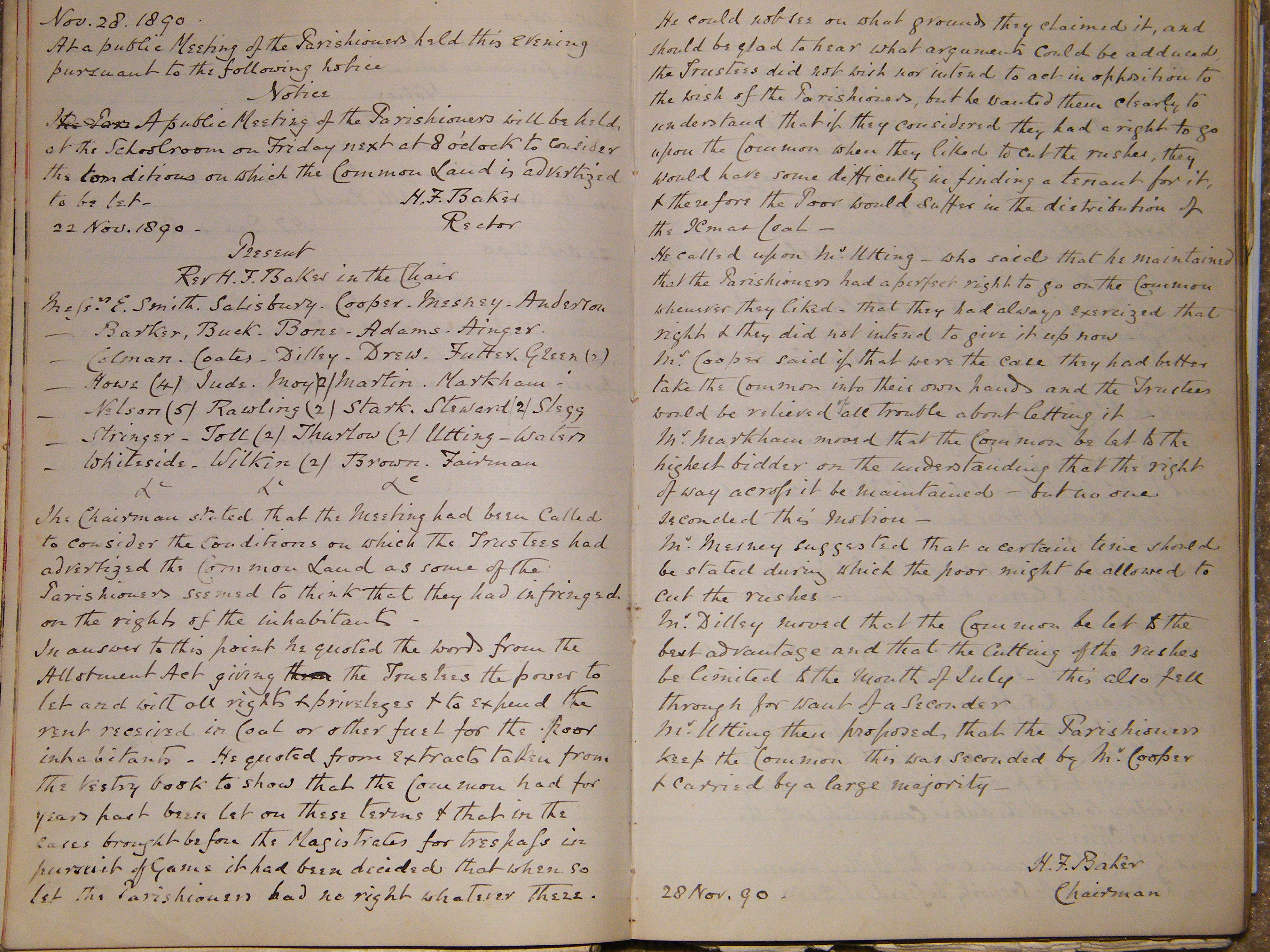
At a public meeting of the parishioners held this evening, pursuant to the following notice
Notice
A public meeting of the parishioners will be held at the Schoolroom on Friday next at 8 o'clock to consider the conditions on which the Common Land is advertised to be let.
H.F. Baker, Rector, 22 November 1890.
Present Rev HF Baker in the chair
Messrs E Smith Salisbury Cooper Mesney Anderson Barker Buck Bone Adams Ainger Colman Coats Dilley Drew Futter Green (2)Howe (4) Jude Moy (2)Martin Markham Nelson(5) Rawling (2)Stark Steward (2)Slegg Stringer Toll (2)Thurlow (2)Utting Watson Whiteside Wilkin (2)Brown Fairman.
The chairman stated that the meeting had been called to consider the conditions on which The Trustees had advertised the Common Land as some of the parishioners seem to think that they had infringed on the rights of the inhabitants.
In answer to this point he quoted the words from the Allotment Act giving the trustees the power to let and with all rights and privileges and to expend the rent received in Coal or other fuel for the poor inhabitants. He quoted from extracts taken from the Vestry book to show that the Common had for years past been let on these terms and that in the cases brought before the Magistrates for trespass in pursuit of Game it had been decided that when so let the Parishioners had no right whatever there.
He could not see on what grounds they claimed it, and should be glad to hear what arguments could be adduced. The trustees did not wish, nor intend to act in opposition to the wish of the Parishioners, but he wanted them clearly to understand that if they considered they had a right to go on the Common when they liked to cut the rushes, they would have some difficulty in finding a tenant for it, and therefore the Poor would suffer in the distribution of the Xmas coal.
He called upon Mr Utting who said that he maintained that the parishioners had a perfect right to go on the Common whenever they liked - that they had always exercised that right & they did not intend to give it up now.
Mr. Cooper said if that were the case they had better take the Common into their own hands and the Trustees would be relieved of all trouble about letting it .
Mr Markham moved that the Common be let to the highest bidder on the understanding that the right of way across it be maintained - but no one seconded this motion.
Mr Mesney suggested that a certain time should be stated during which the poor might be allowed to cut the rushes.
Mr Dilley moved that the Common be let to the best advantage and that the cutting of the rushes be limited to the month of July. This also fell through for want of a second,
Mr Utting then proposed that the Parishioners keep the Common. This was seconded by Mr Cooper and carried by a large majority.
28 Nov. 90 H.F. Baker Chairman
Vestry Book 30th March 1891
Mr Uttin next desired to know what had become of the sum of £40, which he stated had been paid by the Sennowe Estate for permission to cut a drain across the Common.
The Rector replied that he had communicated with Mr Burrowes the late agent of the Estate and has ascertained from him that so far from any money being paid by the Estate the obligation was on the part of the Parish, as the Common had been much improved by it.
Vestry Book 23rd July 1891
A meeting of the householders of Great Ryburgh called to consider a letter received from Messrs Kingsford & Dorman, offering to purchase the Common
Present Rev H.F. Baker in the Chair
Messrs Mesney , W. Rawlings R. Howe, Trustees and between 50 and 60 householders.
The chairman stated that the object of the meeting was to ascertain the feeling of the householders in regard to the sale of the Common an offer having been made to purchase it by Messrs Kingsford & Dorman. As the trustees had conceded to the wish of the householders at a former public meeting to retain the common in their own hands they did not now intend to take the responsibility of selling it without ascertaining first what the feeling of the householders was. He would therefore read the letter to them, and then take the feeling of the meeting on the question. If any present were not householders, he will request them to abstain from voting letter of Messrs Kingsford & Dorman was then read from the chair, and the question was put to the vote Is the common to be sold or not, and it was unanimously resolved, that it should not be sold,
HF Baker, Rector
Vestry Book 30th June 1893
A public meeting held in the school room to reconsider the question of letting the Common called by H. Waters, T.J. Wilkin, Henry Whiteside, and largely attended by the parishioners .
Rev. H.F. Baker rector in the Chair
Messrs E Smith, D Mesney and James Waters Trustees.
The chairman, having stated the object of the meeting, and having expressed his desire that a satisfactory resolution might be agreed upon, which would be conducive to the peace of the Parish on the Common, and to the benefit of the parishioners, called upon those present to give expression to their wishes on the subject. In answer to his invitation, Mr Markham rose, and said he had been deputed by the meeting to express their views, and he wish to know first, if other, if, when the trustees assented to the wishes of the parishioners at a previous meeting to take the Common into their own hands it was to be understood that they by so doing resigned their Trusteeship.
To which the chairman replied, most decidedly, not.
In that case, Mr Markham continued he thought that the trustees had neglected the duty in not protecting the interests of the parishioners by preserving the common from the damage done to the pasturage by cattle straying upon it.
The chairman replied that he considered this was a most unfair and preposterous charge to make when the trustees for the sake of peace and quietness had yielded to the wish of the parishioners and had allowed them for the time to take the management of the Common into their own hands He considered this attack upon the Trustees most unjust.
This view it was supported by Mr Cooper
Mr Uttin then moved the following resolution:
That the common be let with permission to the Parishioners being reserved to cut rushes thereon during a time to be agreed upon by the Trustees and a Committee chosen by the Parishioners to consult with them . The meeting then dissolved .
A Committee of the Parishioners consisting of Mr H Waters, Chas Wilkin, S. Uttin ,Jno Dix & W Rawlings then met the Trustees and agreed to the following terms that the Common be let with sporting rights - permission being allowed to the Parishioners to cut rushes during the six weeks beginning July 1 and ending August 12 th. The reeds to be the property of the tenant
The Trustees subsequently gave orders to the parish constable to impound the cattle now straying on the Common
HF Baker Chairman
Mr Strangleman the owner of the cattle having paid £5 for damage done ,the Bullocks were released .
The following costs were paid to the Parish Constables for watering & feeding Bullocks from July 1 - July 3
H Brown , S Uttin 15/-
Robert Green for labour 4/-6d
James Waters Horse hire 6/-
7th. July 1893
Vestry Book 7th July 1893
A public meeting was held this evening pursuant to the following notice .
Ryburgh Common Land
Notice is hereby given that a public meeting will be held at the Schoolroom on Friday, July 7 at 8 o'clock in the evening for the purpose of letting Great Ryburgh Common on the terms agreed upon at the public meeting held on June 30, 1893
H.F. Baker in the Chair E. Smith, D Mesney Churchwardens
Jas Waters W Oughton Overseers
July 7, 1893
Present Rev. H.F. Baker Rector in the chair
Messrs B Le Neve Foster, E Smith, D Mesney. T Cooper, Jas Waters, Colman, Markham, S Utting, Strangleman and many others.
The chairman having read the notice called upon Mr Beck Auctioneer to read the terms of the letting and then proceed to ask for bids
Mr Markham wished to know as there was no clause in the deed as to the right of way across the Common whether the parishioners were to be prevented making use of it as a road to Fakenham .
The chairman replied that he was informed that there was no right of way across the common and the Trustees could not grant permission to use it.
Mr Beck then proceeded to the auction and the common was let to Mrs G Smith at the rent of £15-0/- for one year commencing August 13, 1893
A vote of thanks moved by Mr Markham, seconded by Mr S. Uttin was accorded to the chairman,
Vestry Book 10th August 1894
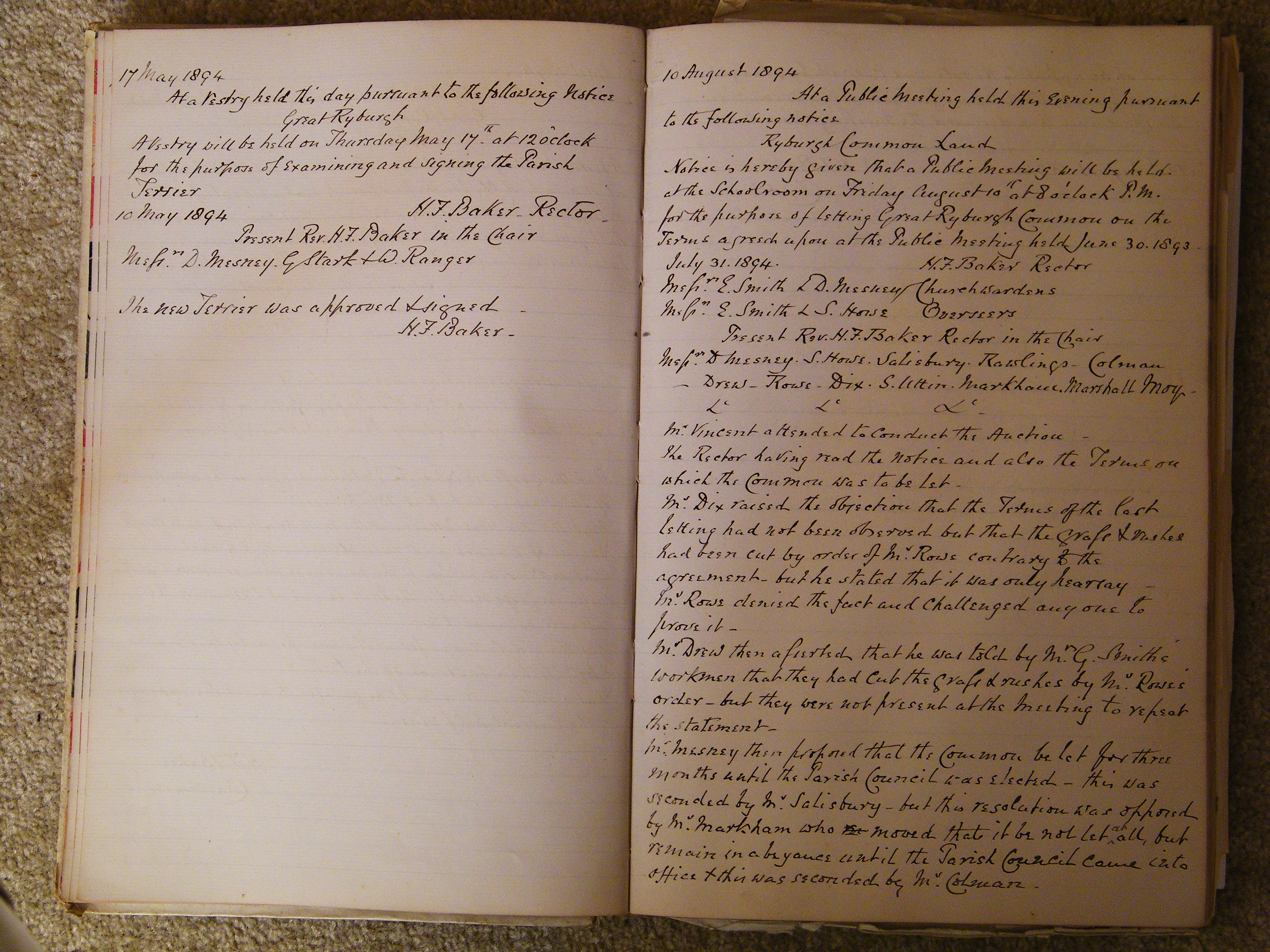
10th August 1894
At a public meeting was held this evening pursuant to the following notice .
Ryburgh Common Land
Notice is hereby given that a public meeting will be held at the Schoolroom on Friday, August 10th at 8 o'clock P.M.for the purpose of letting Great Ryburgh Common on the terms agreed upon at the public meeting held on June 30, 1893
H.F. Baker Rector
Messrs E. Smith &D Mesney Churchwardens
E. Smith & S Howe Overseers
Present Rev.H.F. Baker Rector in the chair
Messrs D Mesney, S.Howe. Salisbury Rawlings Colan Drew Rowe Dix S.Uttin Markham Marshall Moy
Mr Vincent attended to conduct the auction
The Rector having read the notice and also the terms on which the Common was to be let
Mr Dicks raised the objection that the terms of the last letting had not been observed but that the grass and rushes had been cut by order of Mr Rowe contrary to the agreement but he stated that it was only hearsay
Mr Rowe denied the fact and challenged anyone to prove it
Mr Drew then asserted that he was told by Mrs G Smith’s workmen that they had to cut the grass and rushes by Mr Rowe’s order but they were not present at the meeting to report this statement Mr Mesney then proposed that the Common be let for three months until the Parish Council was elected - this was seconded by Mr Salisbury -but this resolution was opposed by Mr Markham who moved that it be not let at all but remain in abeyance until the Parish Council came into office and this was seconded by Mr Colman and I'm being put to the vote was carried by a large majority, only three voting for Mr business resolution. The chairman then declared the meeting closed.
10th of August 1894
H. F. Baker,
Chairman
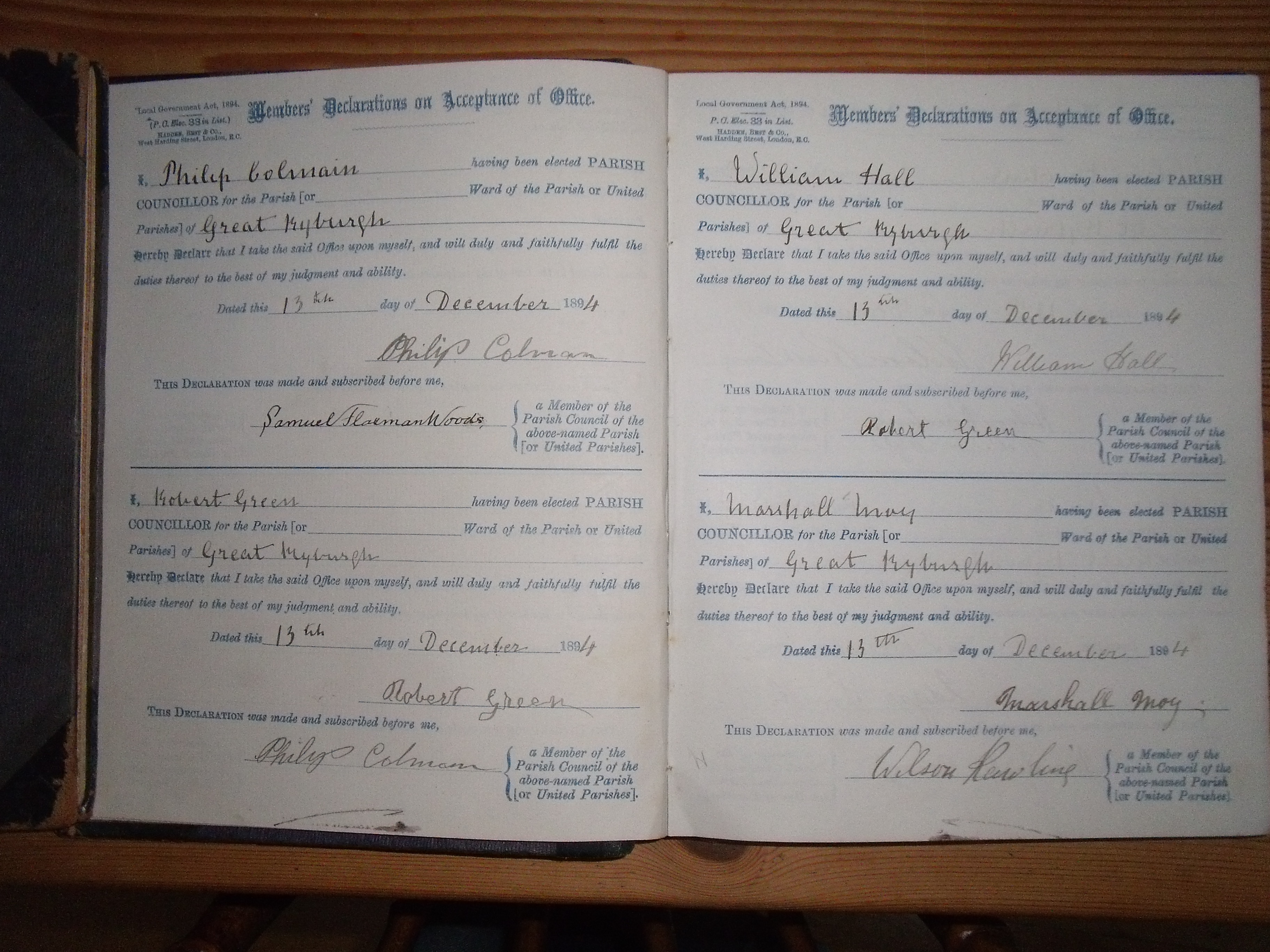
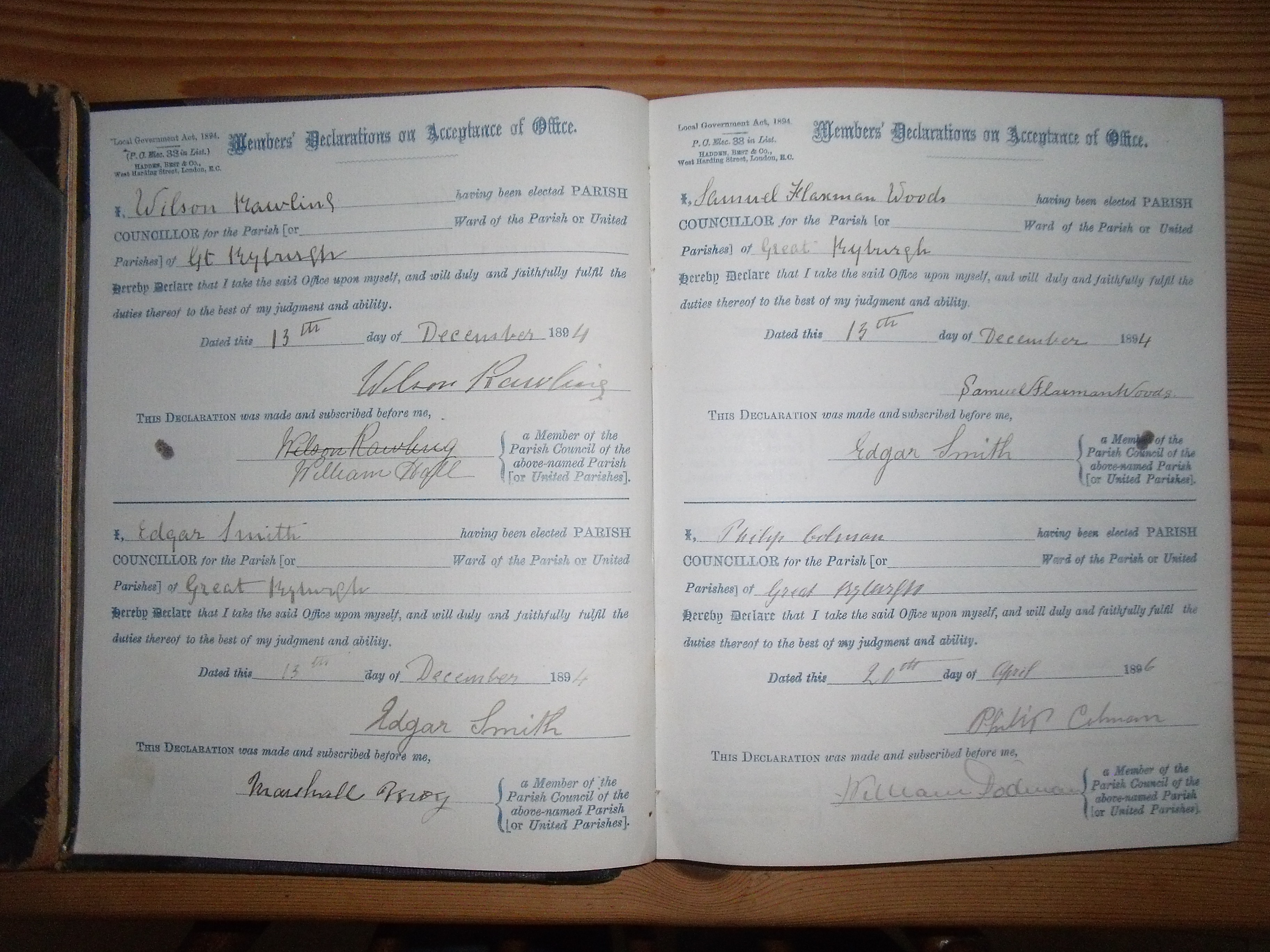
Thereafter the “Common “ does not appear again in the Vestry Book, neither do Overseers or Parish Constables. Nor yet do many of the names of villagers found in those early pages appear again. If we take a look at the Parish Councillors who were elected to their post as the first ever Parish Council on December 13th 1894 . We see but one or two familiar names, though not the more prominent names of Uttin(g) Markham, Rowe, Mesney or Dilley, Dix to name but a few of those who previously were quoted in the minutes.
The new administrators of the Parish Council were as follows:
Philip Colman, Robert Green, William Hall, Marshall Moy, Wilson Rawling, Edgar (Ned) Smith, Samuel Flaxman Woods,
It is not known If the previous Trustees of the Fuel Allotment Charity (Edgar Smith , David Mesney and James Waters) continued in post after the change of its umbrella organisation. As we see from the last letting made by the Vestry and as had been the case hitherto, the tenants of Highfield Farm alongside whose land the Allotment lay were the obvious candidates for managing the land ..........a situation that has endured to the present day.