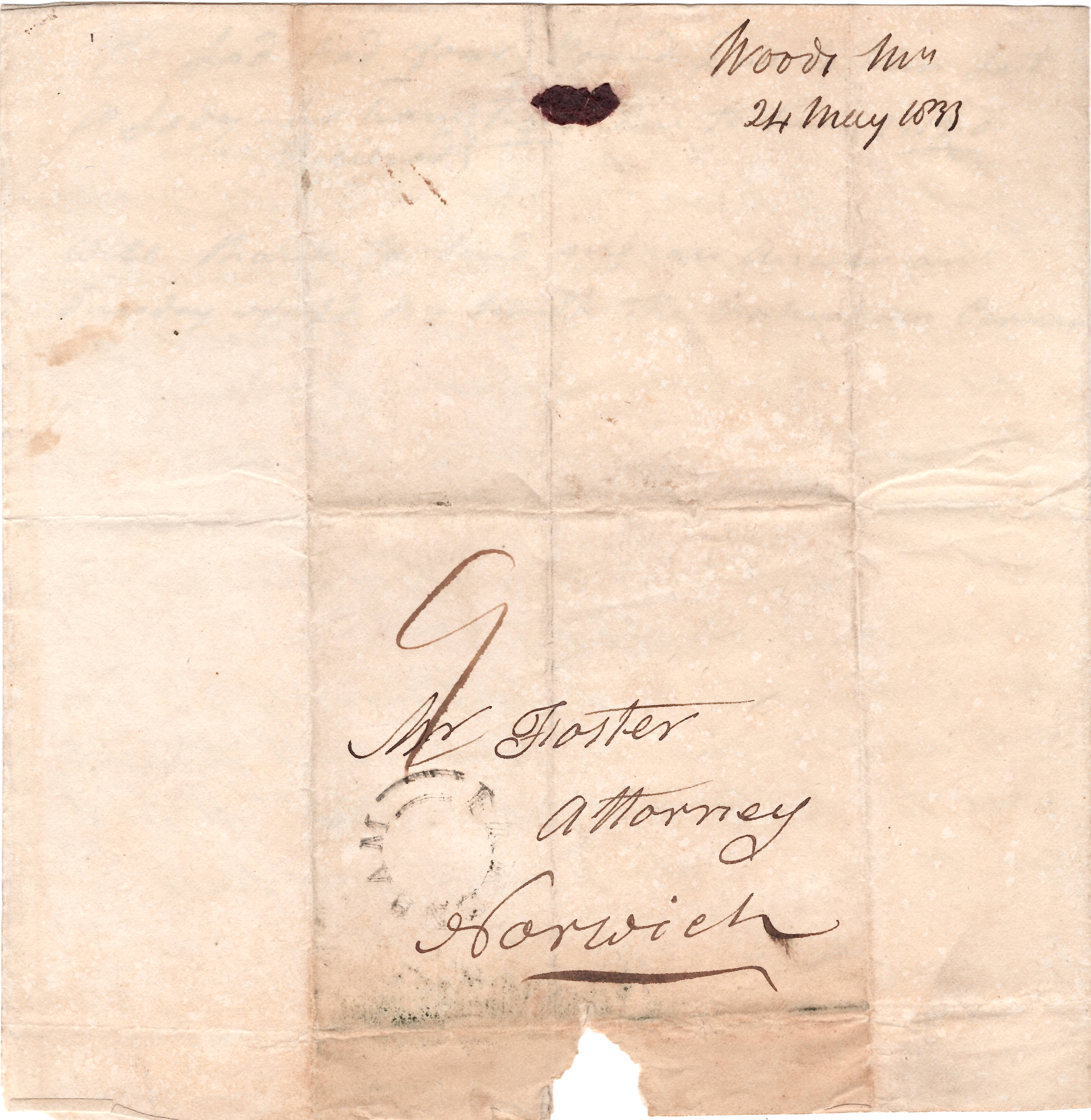
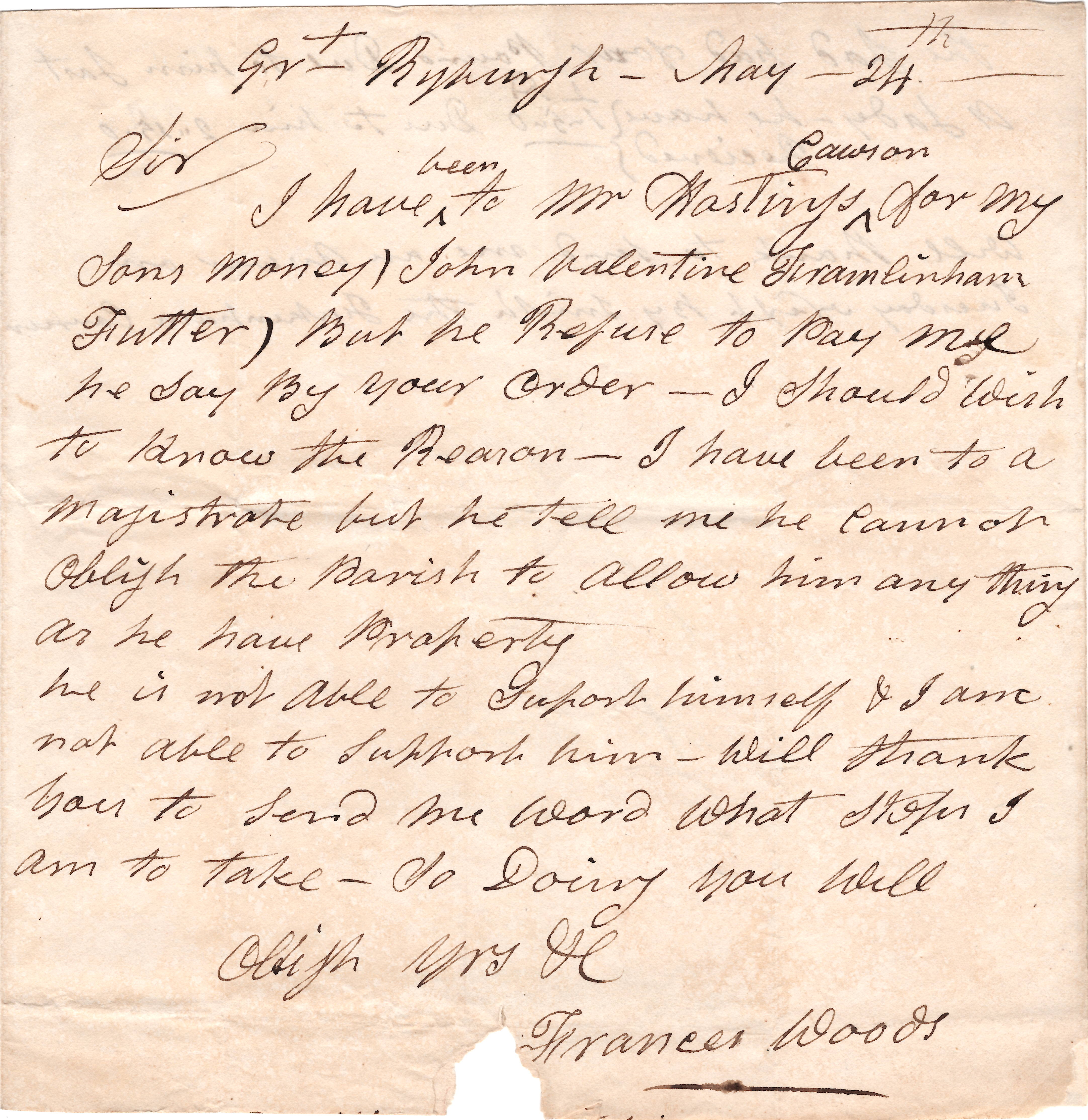
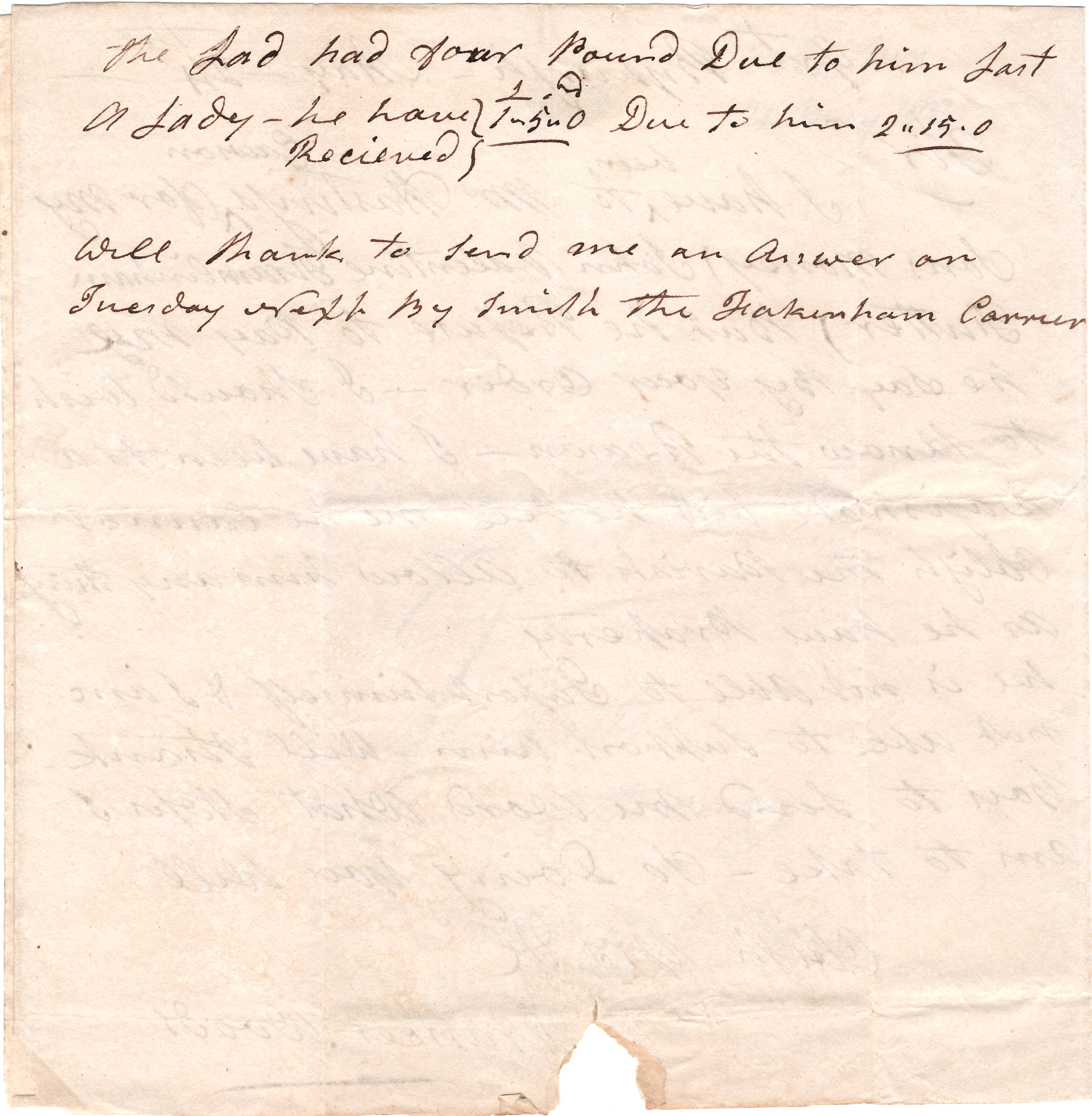
In common with many people I rather like a puzzle to solve, and the sort of puzzle that appeals to me turned up on the internet recently and fired my enthusiasm. It was embodied in the letter above from a Mrs Frances Woods to a Norwich Attorney, Mr Foster (most likely William Foster III of the noted firm of Foster and Unthank) and written on the 24th May 1833. It concerned the financial affairs of her son, then aged 11 and reads as follows:
Woods Mrs
24 May 1833
Mr Foster
Attorney
Norwich
Grt.- Ryburgh – May - 24th -
Sir,
I have been to Mr Hastings at Cawston for my
sons money (John Valentine Framlingham
Futter) But he refuse to pay me
he say by your order - I should wish
to know the reason -I have been to a
magistrate but he tell me he cannot
obligh the parish to allow him anything
as he have property.
He is not able to suport himself & I am
not able to support him – Will thank
you to send me word what steps I
am to take – so doing you will
obligh Yrs &c
Frances Woods
The lad had four pound due to him last
a lady – he have recieved £1 5/- ) Due to him £2 15/- 0
Will thank to send me an answer on Tuesday next by Smith the Fakenham Carrier
This letter had surnames that were familiar but at first I could find no other evidence of a Ryburgh connection for Mrs. Frances Woods and so began the search. In the first place for the son, John Valentine Framlingham Futter who, with a distinctive name like that, soon turned up in the Ancestry searches. Through one particular public member tree, managed and researched by Christine, I found a Frances Clements from Great Massingham whose parents were Valentine Clements 1761-1840 and Elizabeth Framingham 1765-1827. They married on October 23rd 1781 and Frances born on April 18th 1787 would seem to be the fourth of their surviving children.
Frances married Samuel Futter an elderly widower on November 2nd 1807 at Great Massingham and as neither could write so left their marks in the Marriage Register. This points to the letter having been dictated by Frances as the handwriting is fluent though the spoken dialect is clear. They went on to have seven children, the two eldest, Maria born 1808 and Marianne born 1809 had both died by 1811. The remaining offspring all appear to have survived to adulthood. The family remained in Great Massingham until circa 1821 when they moved to Wood Norton where John Valentine Framingham Futter was born in 1822 . Samuel however, some 35 years older than Frances died probably in late February the following year and was buried soon after in Wood Norton on March 2nd 1823.
Frances, now aged 36, found herself a widow with 5 children under 10 to care for and from Wood Norton to Stibbard is where we find that the following year April 5th 1824 she married an elderly bachelor, Thomas Sturman. They went on to have two children, Ann Maria baptised October 3rd 1824 and Isaac baptised September 24th 1826. The following year was another turning point for Frances when Isaac Sturman died and was buried at Great Ryburgh on May 2nd 1827 and his father 61 year old Thomas also died and was buried on August 5th 1827 also at Great Ryburgh. This is the first time we find the connection of Frances with Ryburgh.
The next stage of the search, again thanks to a suggestion from Ancestry member Christine, found widow Frances Sturman marrying widower William Woods by Licence on July 12th 1828 at the Parish Church of St Agnes, Cawston. The officiating clergyman was Revd. Josiah Webb Flavell, Rector of Stody since 1801,who had been curate for Charles Morduant at Ryburgh before William Ray Clayton was appointed to St Andrew’s in 1820.
A further look through the Ryburgh registers found just one entry: the baptism of Walter, son of William (labourer) and Frances Woods on October 19th 1829
Returning to John Valentine Framingham Futter we find, rather unfortunately, that he is recorded in 1836 as a 14 year old, in the Assize records of Norwich Gaol. He was however on this occasion acquitted of a the charge of larceny. To be more specific : Committed March 14, 1836 by the same magistrates (as the indicted man above him in the list), charged on the oath of Luke Ainger, of Great Ryburgh, ale-house keeper, with having, on the 12th. of the same month, stolen three pecks of potatoes. (in the region of 20.5 Kilos). This immediately caught my attention because that ale-house was on the site of the later named Marine Tavern, and where I now live. His co-defendant was named as 34 year old William Woods, suggesting that he might perhaps have been stepbrother or stepfather to John V.F.Futter?
In the first Census for Great Ryburgh in 1841 we find our 35 year old publican Luke Ainger with his family and living next door are 26 year William Woods and 24 year old John Woods both shoemakers. Rather frustratingly, neither of these young men could be the husband of Mrs Frances Woods and what is more, there are no other Woods names in Great or Little Ryburgh in 1841.
On the second occasion we meet John V.F. Futter he was imprisoned for 3 months being recorded for an unspecified “larceny” in the indictable offences register for 1838.
He has yet to surface in the 1841 Census but I next encountered him in 1843 in the course of a British Newspaper Archive search which put a whole new light on the letter, especially since his mother had written 10 years earlier that Mr Hastings said: “he cannot obligh the parish to allow him anything as he have property”. The following press reports portray a naive young man taken advantage of, by both the cunning of the streetwise and the legal profession.
28th January 1843 Norwich Mercury:
Another Robbery on the Hill.- On Wednesday last, a girl who gave her name Matilda Buck, from the William Tell public-house, on the Castle-ditches, was brought before the Magistrates by Sergeant Peck, charged with stealing about £30 from the person of a young man named John Valentine Framingham Futter, a labourer, who lives at Cawston. The complainant stated he had just come of age, and had received a small property which had been left him by his father. On the preceding day he came to this city with a young man to purchase a horse, and when he left home he had £55. He did not agree to purchase it, in consequence of the man wanting £30. He offered him £20. He then went to the Elephant public-house, and had his dinner, after which he walked out, and went to the William Tell, when he met with the prisoner. and after they had drank together retired to another room. During the time they were in this room, the landlady took them three glasses of gin and water and three pints of porter, and also gave him something in a pewter pint pot, telling him to drink it, which made him quite stupid, and be was afterwards very sick. He missed his purse from his trowsers pocket, and accused the girl of stealing it. The landlady, who was in the room, told him he put it into his coat pocket. He felt on the outside of his coat and found it was there, but did not look at the contents. After some little time he left the house, and when he got to his quarters the young man asked him where he had been and where his money was? He was so ill from the effects of what had been given him, that he could not, for near half an hour tell him; during which time be was again sick. He was at last sufficiently recovered to examine his purse, when he missed a £5 note and gold and silver to the amount of £30. Information was immediately given to the police, and the girl was apprehended, but nothing was found upon her. He stated, in answer to the Magistrates, that he was sure the purse was in his trowsers pocket, and he never put it into his coat. He also felt something drawn over him, and said to the girl "you are after my watch." The landlady said "here is your watch." He said he had once before lost a seven guinea watch at a similar house. The young man who had accompanied him to Norwich said he was sure he had £55 in his pocket when he came into the city, and that he did not see him till the evening, when he missed his money, which made him very unhappy all night. The landlady, whose name is Susan Eagleton, was apprehended, and the complainant having made the charge against her. she endeavoured, in a round-about manner, to explain to the Magistrates the whole affair, confirming the statement made by Futter. The Magistrates remanded both prisoners for further examination until Saturday next.
Feb 4th 1843 Norfolk Chronicle:
SWORD ROOM.
ROBBERY FROM THE PERSON.-On Saturday last, Susan Eagleton and Matilda Buck, of the Castle Ditches, previously remanded, were again brought before the sitting Magistrates, charged with having robbed a young man named John Valentine Framingham Futter, of Cawston, of £30. on Tuesday Jan. 24th. The same evidence was adduced as at the previous examination. Mr. Mendham was employed for the prisoners, and cross examined the young man Futter at great length, but did not shake his evidence-the principal points of which were that the prisoner Eagleton had given him drugged porter to drink, which made him stupid, also that his purse had been removed from his breeches to his coat pocket. He was certain that he had £55 in his purse when he went into the house and only £23 and 23 shillings when he left.-A £5 note was produced marked in one corner with red ink, and Futter being asked if he could identify it, said, it was like the one he had lost; and there was a red mark on the note of which he had been robbed. Mr. Hudson asked the prisoner Eagleton if she had not left her house to change a note immediately after the robbery? She denied having done this.-Mr. Hudson said he thought they would be able to prove it upon her trial. -The prisoner Matilda Buck being asked what she had told her mother about the business, said, she had told her mother that a robbery was going to be done, but that she (Matilda) would have nothing to do with it, but that Jigger (a nickname for one of the girls) would do it. In answer to Mr. Hudson she said the landlady (Eagleton) had given the young man some porter to drink, but neither she nor the landlady drank any of it. She preferred the gin and water. After a long investigation into the case, both prisoners were committed for trial at the sessions next ensuing.
On the same page of the same paper:
On Thursday, Susan Eagleton and Matilda Buck, of the Castle Ditches, were again brought before the Magistrates; but no further facts were elicited, except a statement from Buck, that laudanum was put in the porter given to Futter. After another long hearing of the case, in which the same statements were repeated over and over again, both prisoners were fully committed for trial at the ensuing sessions.
1st April 1843 Norwich Mercury:
Matilda Buck, aged 16, and Susanna Eagleton. aged 39, stood charged with having, on the 24th day of January last, feloniously stolen twenty-five sovereigns, and one promissory note for the payment of five pounds, from the person of John Valentine Framingham Futter, of Cawston, The statement of the prosecutor was given at full length at the time the prisoners were committed for trial by the Magistrates. Mr Wm. Cooper, who appeared for the prisoners addressed the Court in a very humourous manner, and caused one continued laugh at the expence of the prosecutor, and the Jury acquitted both prisoners.
There is a third entry in the crimunal registers for 1846 that names a John Futter, aged 24 sentenced to 14 days imprisonment followed by 7 years transportation for 2 convictions of larceny. It is not possible to be entirely sure if this is our John V.F. Futter, but the strong circumstantial evidence points very convincingly to it being him, meaning that we are now able to follow him further to a conclusion.
Norfolk Chronicle - Saturday 24 January 1846
SWAFFHAM SESSIONS
These Sessions were held on Wednesday and Thursday, the 14th and 15th inst., before
Lord Walsingham, Chairman; Wm. Mason, H. B. Caldwell, T. R. Buckworth. jun. Esqrs. and other magistrates. -There were 48 prisoners for trial;-a larger number, we regret to say, than usual. At the January sessions, 1845, there were only 23.-We give the results of the trials. Those marked thus,* had been previously convicted.
To be transported for 14 years.- *John Parker, 29, for stealing, on the 22nd of November, at Southery, a donkey, the property of Wm. Rogers, carrier. -For 10 years: Thos. Mitchell, 45, charged with wilfully killing a sheep, the property of Mr. Luke Fox of Tilney-cum- Islington, farmer. -For seven yeurs.—*John Futter, 20. who was found guilty on two indictments, for stealing two donkeys. the property of Henry Jary, of Cawston, tailor; and Thomas Clements, of Sall, labourer; on one of which he was also sentenced to be imprisoned for 14 days.
From the gaol at Swaffham he was taken to the convict hulk “Justitia” moored at Woolwich on March 27th 1846 where he is registered in the quarterly muster at the end of that month. He is deemed healthy with good behaviour . By the recording of the 2nd quarterly muster he is described as “sick” and he remains so until the 5th muster where his entry reads “died 20th April 1847”
***************
The story behind the letter doesn’t end here however, as in the course of researching, Samuel, Futter, Frances’s older son by her first husband kept on cropping up.
Samuel Futter junior was born in April 1815 in Great Massingham, Norfolk. He would have been 8 in 1823 living in Wood Norton when his father died, then living in Stibbard and Ryburgh aged 9 onwards with his mother Frances and successive stepfathers, Thomas Sterman between 1824-26 and William Woods in 1828 and after. At what point he took the King’s shilling is not known but he is likely to have been soldiering by the time his mother penned her letter on younger brother John’s behalf. He was serving in 3rd Battalion Grenadier Guards when on Jan 2nd 1834 he received 4 months H[ard] L[abour] for “Desertion and loss of necessaries”. On May 21st 1834 he is described as having deserted on May 10th in London in the War Office’s “List and description of Deserters from His Majesty’s Service” This list published in the Police Gazette “Hue & Cry” gives the following description of this young man:
Age: 19
Parish: Great Massingham
County: Norfolk
Trade: Labourer
Height: 5 ft 8”
Size: prop.
Head: prop
Face: prop
Eyes: light brown
Nose: common
Hair: brown
Arms: prop
Legs: prop
Mouth: common
and wearing Reg[imental]red coat and white Trowsers and with no distinguishing marks.
He deserted again and was court martialed on 20th September 1834 in Dublin and ended up with 6 months hard labour for the privilege. So far we can be sure he is our Samuel Futter but from now on the identification is only very strongly circumstantial as we continue our researches, we have yet to trace Samuel from his Military predicament to the next appearance in the records.
In the “Register of all persons charged with Indictable Offences at the Assizes and Sessions in Norfolk 1836” we meet Samuel Futter who was tried and convicted of Horse stealing on 18th October 1836. More specifically stealing a mare, gig and harness for which he was sentenced to transportation for life. He was taken from the City Gaol in Norwich on November 5th 1836 to be placed on board the “York”, a Hulk moored at Gosport ,where he appears to have been hospitalised for a period before being transported to New South Wales on March 15th 1837.
He arrived on July 9/10th 1837 at Port Jackson on the Ship “Mangles” along with 309 other male prisoners. Now aged 22 he was then dispersed to a Master in the District of Yass, where would be stationed, his Master being one W. H. Yaldwyn. On arrival we have another description of Samuel Futter several years after statistics were collected on joining the Grenadier Guards. They broadly tally, though he is now 5ft 11 ¾ inches tall ruddy and freckled with brown hair and hazel eyes. Along the way he has picked up some distinguishing marks: “Scar inside right wrist, two scars fore finger of left hand, whiskers meeting under the chin”
According to the Mangles' Surgeon’s Log, Samuel Futter had been on the sick list twice during the voyage:
On April 7th-8th with constipation and again on: May 3rd-4th with Cephalalgia (Migraine/Headaches)
This official record gives a real insight into life on board, penned by Mangles Ships Surgeon Francis Logan:
"The soldier Shufflebottom having been only one or two days out of jail greatly debilitated and too thinly clothed for the season of the year, particularly to be out in a boat a whole night what has followed might be expected."
(Robert Shuffelbottom Aged 28 Private soldier joined the ship 7th March at Deptford suffering from Tuberculosis. He died on April 20th. Dr. Logan writes:
“At 2 p.m. departed this life – I have never seen any person live so long in so weak a state as this man has done”)
fo. 24.
General remarks
“There is no doubt that the cases of Dysentery (during the voyage) were occasioned by the wetness and filth from the water closets as all the cases that occurred were in the beds that the drainage came down on. When I wrote to the Admiralty I was not aware that the water closets were fitted up by the ship I think the surgeon should be informed of anything of the kind that he might immediately apply to the proper quarter for amendment or alteration.
fo. 24v.
"It will be seen that scurvy made its appearance at a very early part of the passage which was in a great measure owing to the men not drinking their cocoa and the quantity of oatmeal being only sufficient to give one half of the usual ration for six or seven weeks. Not one of the soldiers could drink it and it appears to me that landsmen take a thorough disgust at it during the commencement of the passage whilst they were sea sick and that the nauseous feeling is kept up partly by recollections and partly from sympathy – whatever may be the cause the thing is certain that landsmen in general take a loathing and disgust at cocoa on board a ship. At first I thought it was partly obstinateness but was soon convinced to the contrary as it made some of them sick instantly and nearly all felt nausea – only eighty of the prisoners could drink it – tea is the universal wish and I am not certain if the expence would be much greater – Allow me also to remark that none of the prisoners who drank their cocoa came on the sick list for the cure of scorbutus.” (scurvy)
The last trace of Samuel Futter that we’ve so far found is in December 1842 printed in the Government Gazette. It is not clear whether he is just being accounted for or whether he has absconded, which is the case with the very many lists of men in preceding paragraphs. The statistics have clearly been taken from the arrival information from 5 years earlier:
Futter Samuel, Mangles 7, 27, Norfolk, horse-shoer, 5 feet 11¾ inches, ruddy and little freckled, comp brown hair, hazel eyes, scar inside wrist, two scars forefinger of left hand, whiskers meeting under the chin, from W. H. Yaldwin, Melbourne, Port Phillip, since 4 April,
***************
After the baptism of Walter Woods at St Andrew's in 1829, there is no futher identifiable mention of William Woods. Walter has not been traced again until the Census of 1841 when he is living in Cawston, aged 14 with Frances his mother and older stepsister Maria Sterman (b 1823). It is at this point that the trail for Walter Woods goes cold.
In the 1851 Census, Frances is now identified as a widow living in Cawston. With her are U[nmarried] Robt W Woods, born Great Ryburgh, her son aged 19 and Robt W Woods Grandson aged 5, born in Cawston. This grandson, Robert W Woods was in fact the illegitimate son of Ann Maria Sterman and who was baptised in Cawston on March 28th 1846 in the name of Robert Walter Townshend Stearman. It points to a local Townshend as the father of the child but no one obvious comes to mind so far.
At the same time we now find Robert Walter Woods featuring in the local newspapers. This time it is a different sort of misdemeanour to that of his half brothers but nevertheless one which occupied a number of column inches in the local press. It was first reported in February 1851 with the follow up in March that year:
Norfolk Chronicle - Saturday 08 February 1851
Wesleyan Dissensions.
The dissensions in the Wesleyan Methodist body continue to cause great excitement in Cawston and its neighbourbood, where the "reformers" appear determined to annoy the regularly authorised preachers in every way in their power, by inciting parties to disturb the congregation on Sundays. The superintendent of the district has, in consequence, been obliged to proceed against those parties. On Tuesday, at Aylsham Petty Sessions, a lengthened investigation took place, relative to a disturbance at Cawston chapel, on Jan. 19th. The Magistrates present were W. E. L. Bulwer, Esg.. J. H. Holley, Esq., the Rev. S. Pitman, and the Rev. E. T. Yates. Four persons, named Elizabeth Southgate, John Smithson, Walter Woods, and Thomas Chapman, all of Cawston, appeared to answer an information under the 52 Geo. 3, s. I2,charging them with having, in that parish, on Jan. 19th, wilfully, maliciously, and contemptuously, disturbed a congregation of protestants assembled for public worship. -The Rev. C. Porah preferred the information, Mr. Drake of East Dereham, appearefor the prosecution, and Mr. Scott for the defendants.—The room at the Black Boys inn was quite crowded, and the case appeared to excite considerable interest. Mr. Drake having stated the case, proved the registry of the chapel, and called the following witnesses Samuel Woodhouse, a constable, deposed: - I went to Cawston, on Sunday, Jan. 19. I went to a cottage opposite the Wesleyan Methodist chapel in that place: The window of that cottage is opposite the principal door of the chapel; I could see the entrance to the side door as well as the front. l was there before the morning service began in the chapel. I then saw Southgate, Chapman, Woods and Smithson opposite the front door. They were outside of the chapel yard, talking, laughing, and so on; they went backwards and forwards on the road. After that, they all went into the chapel yard again, except Chapman At that time they were making sufficient noise to be heard inside of the chapel. I saw Southgate, Smithson, and Woods afterwards go into the chapel. I believe Chapman went in. They remained in the chapel some little time; then Woods, Smithson and Southgate came out. They went in and out of the chapel repeatedly. After that, Smithson, Woods and Southgate came out and went over the road. They passed the window where I was and stepped under the wall. I saw mud and filth thrown from the place where the parties stood at the chapel door. I could not see the hand that threw it. They left that spot and went into the chapel yard. I then saw Chapman also go into the chapel. After that, I again saw Smithson outside of the chapel; he was standing with some others. I saw him, with another, take the gate off the hinges and place it against the chapel-door; on the brass handle of the door. It was a railed gate, and the effect of placing it in that manner was to prevent the people inside from opening the door. During the whole time I was there from 10 till 12, the parties were about the chapel, laughing talking, and making noises. I stopped in Cawston all night, and on Monday morning I was at the King’s Head public house, where I saw Woods with Dye, the police. He asked Dye to go out with him, and they both went out together, They returned, and Woods said the woman Southgate enticed them to go to the chapel, He said he did not put the gate on.- Cross-examined. I was sent to watch by my superintendent. I do not know any of the members. I did not keep a watch the whole time. During the service, not one respectable person came out; I did not see any person come out of the chapel. Woods went in and out 4 or 5 times. The parties went in at the back door and I could not see them again. If I thought the conduct of any parties was bad outside of the chapel, I should ask them to go away. I think the conduct of the defendants was such that I should have told them to move on. Mr. James Davison said. I am a local preacher in the Wesleyan Methodist society. I was appointed to conduct the service at the chapel at Cawston, on Sunday, January 19th. I did conduct the services. After I had commenced the service. I saw Smithson. Woods, and Southgate come into the chapel This was during the forenoon service. 1 commenced a little after 10h. 30m. After coming in, Smithson, Woods, and Southgate did not remain in, but kept continually going in and out and rapping the door to. After I commenced, Smithson came in with his cap on, and kept walking backwards and forwards in the chapel, and up and down the gallery. The other defendants stood with their caps on, laughing and talking. Singing had been begun. Being greatly annoyed by them, and disgusted with their conduct, I went to them, and asked them to sit down and behave as they should do. They said they would not. I then asked them to go out, and they said they would not do that either, They said, I had better go home, or else I would get my head broke. Woods said so. While the woman was in the chapel, she kept talking and laughing. After that, Smithson and Woods went in and out repeatedly, and rapped to the door. Smith-son's cap was thrown into the chapel, and he came in after it. Dirt was thrown in. At the latter part of the service, nobody went in and out of the front door. At the conclusion, the congregation could not get out at the door, it being fastened. After that I saw the parties outside, and I spoke to them about fastening the door. I asked them what good it did them, and they said, it did not do them any good, but they would make the chapel the sign of the gate. I asked them what harm I had done them, and they said, none; but said, I had better go home, or else I would get my head broke. This was not the first or second time, and others have been threatened in the same way. Woods said they had done this because of the conference party. The woman Southgate used abusive expressions to me, saying, " You poor snotty thing, you better go home," and suchlike. Singing is a part of the service; and after it was over, I considered it my duty to go and expostulate with the parties. I thought it was necessary to go and speak to them. I particularly referred to Woods, when I spoke to them Southgate and Smithson were present at the time.-Cross examined. The course of the service was first singing, then praying, then reading a chapter, then singing again, then remarks on the word. Then we concluded in our usual way, by singing and prayer. There was interruption during the first singing, and after it I was so greatly annoyed that I left the pulpit, and went to the parties and spoke to them. There would have been longer singing but for the interruption. I was on greatly annoyed that I could not go on. In my opinion they were wilfully and maliciously disturbing the service, Woods stood against the door with his cap on, laughing and talking. The woman was laughing and talking with the others. I entreated them to behave as they should do. I do not recollect when the cap was thrown. Woods told me twice, that my head would be broken; and the first time he said so was in the chapel. I saw dirt come into the chapel, thrown in by someone. Mr. Scott, in defence, argued, that there was not such a disturbance of the congregation as to come within the meaning of the act; that there was no proof of anything against Chapman; and that the evidence against the other defendants only showed a certain degree of misbehaviour, which did not amount to an indictable offence. He offered to call witnesses to show that there was no great disturbance; but as this was like a case of felony, he had not the power of offering evidence on oath. Mr. DRAKE had no objection to the witnesses being examined, and said, that such was the excitement in the locality, not a single member of the congregation dared to appear there to give evidence. No witnesses were called for the defence, and the depositions which had been taken were read over. The Magistrates having consulted, Mr. BULWER said, they had come to the conclusion, that there was not sufficient evidence against Chapman, who would be discharged; but they decided, that the other three parties should each find two sureties of £25, to answer an indictment at the Sessions.
Norfolk News - Saturday 15 March 1851
DISTURBANCE AT THE WESLEYAN CHAPEL, CAWSTON.
John Smithson, aged 18, Robert Walker(sic) Woods, aged 19, and Elizabeth Southgate, aged 30, were indicted upon the charge of having, on Sunday, the 19th of January, unlawfuily disturbed a congregation of Protestants lawfully assembled in theWesleyan chapel for the purpose of religious worship. They pleaded not guilty. Mr. Evans and Mr. Palmer appeared for the prosecution. The prisoners were undefended. Mr. Evans stated the case. He said that the prisoners were indicted for a misdemeanour under an Act of Parliament passed in the year 1813, being the last Act of Parliament that was passed upon the subject, and was called the Toleration Act. The word toleration was now happily almost unknown, because nobody ever interfered with the opinion of his neighbour. The act to which he alluded stated positively that if any person or persons should wilfully and maliciously and contemptuously disquiet and disturb any meeting or assembly, or congregation of persons assembled for religious worship, as sanctioned by any former Act of Parliament, he or they should be liable to be held to bail to appear at the sessions; and, being convicted of the offence, should be liable to a penalty of £40. Before he detailed the particulars of the case, he felt bound to state to the court what was asked at the outset of the proceedings against the defendants, that the only objects of the parties he represented on this occasion was, that they might be permitted, without any molestation, to worship God after their own fashion. They did not wish to inflict any degree of punishment whatever; all they wished to obtain was an acknowledgment that the parties had done wrong, and would not do the like in future. If the parties had been well advised, instead of pleading not guilty as they had done-for there could be no doubt that they took part in the proceedings with which they were charged-he (Mr Evans) should have asked the court to have passed no sentence, but to have held the prisoners in recognizances to appear in the court next quarter sessions, if any outbreak should take place in the interim. If they should be found guilty, the court would have no discretion, for the Act of Parliament provided that they shall pay a penalty of £40. If he was compelled to call upon the court to pass the sentence, he was well aware that the prisoners in their circumstances of life could not pay the penalty of £40, and the consequences would be that a process would be issued to levy the goods and chattels to the amount of the penalty, and it the parties had not sufficient wherewith to cover the amount, a return would be made to the Court of Exchequer to such an effect, and the prisoners would then be taken into custody, and would have to remain in prison so long as her Majesty the Queen should think fit. The learned counsel then proceeded to allude to the recent movement in the Wesleyan body by a party calling themselves Reformers, and to the attempt which had been made to obtain possession of the chapel in Cawston, which had led to a proceeding being instituted in the Court of Chancery, from whence an injunction had been issued to restrain the parties so offending. He then stated the facts of the present case at length, which we give as the witnesses deposed. At the conclusion of his statement the defendants Southgate and John Smithson, on the recommendation of Mr. W. Cooper, who had voluntarily advised all the defendants, withdrew their pleas of not guilty, and pleaded guilty, promising not to go near the chapel again. Woods, however, persisted in his plea of not guilty. Mr. Alfred Smith deposed-I come from Mr. Kitson's, the registrar's office. I produce the certificates of the registered conventicles. I find that the chapel at Cawston was registered on the 13th of November, 1816. Henry Gayford deposed that there was no other chapel in the parish of Cawston. Samuel Wodehouse said—I am a police officer, and reside at Hardingham, which place is not in the district of Cawston. I know the Cawston chapel. There is a cottage opposite. I was instructed on the morning of Sunday, the 19th of January, to go to that cottage in plain clothes, and watch the proceedings. There are two doors to the chapel, a principal door and a side door. I could see the fore door and the way to the side door from the cottage where I was watching. It was about ten in the morning before the commencement of service that I went to the cottage. Whilst I was there I saw several persons by the chapel door. I saw Woods at different times making a noise and laughing outside of the chapel. I then saw Woods go in and out of the chapel several times. He kept in sometimes five minutes and sometimes more. I saw some dirt and mud thrown at the chapel door. It was from a party standing against the window, but I could not see the hand that threw it. Some of the mud went into the chapel. I saw Smithson with another person then take a railed gate off the hinges, and place it on the handle of the chapel door, which prevented parties from getting out. I stopped at Cawston all night, and on the Monday morning I was at the King's Head, and heard Woods say to a person named Dye, that it was the woman Southgate who induced him to go to the chapel and do what he had done. The congregation was in the chapel nearly two hours. James Davidson deposed-I live at Aylsham. I am a local preacher of the Wesleyan Methodist Society. I was appointed to preach at Cawston chapel, on Sunday, the 13th of February. I went there, and attempted to conduct the service. After I commenced the service, the prisoner at the bar walked in and out of the chapel several times, laughing and talking aloud. There was a screen before the door, and when he had passed that I heard the door slapped to. Whilst he was in the chapel his hat was on his head. His conduct was such as disturbed the congregation. I went to him and said you had better keep in and behave as you should do. He said he should not do that. I said you had better leave the chapel, for that is not the place to laugh and talk and disturb us. Afterwards Woods said to me that I had better go home. He then asked me whether I was going to stop till night, for if I did I must look out and see that I did not have my skull broken. After I left Woods I returned to the pulpit, and then I saw some dirt come into the chapel from the direction of the door. I also saw a cap come in the direction from the door. I went through the service as well as I could under the circumstances. Cross-examined by defendant -You asked me whether I was going to stop till night. You said if I did, I must mind and look out that I had not my skull broken. Defendant then said it was false; he had a witness to prove that he did not say so. Re-examined.-I am quite sure that Woods is the person who made use of that expression. I saw him after the service was over. After the service was concluded tie congregation went to the principal door to go out, but it was done up, and we were obliged to go out by the side door. When I got round to the front door I saw that it was a gate hung on the door that prevented our getting out. I then saw Smithson, Southgate, and Woods, and I said to them I am surprised at you, that you do not do better than this. They said that that was the sign of the gate. They also said that they had nothing against me, but that they did it because of the Conference party- John Comer, of Cawston, labourer, who was one of those assembled at the chapel on the day in question, corroborated the entire statement of the previous witness. Police constable William Dye, stated that on the Monday morning, February 20th, the prisoner Woods said that Southgate coyed him and the others on the previous day, as she always did. The prisoner in his defence said that he went into the chapel and sat inside the door, just after the service had been commenced, and remained there till after it was concluded, when he came out with Mrs. Southgate and a person named Blyth. He then called as his witness a man named James Chapman, who said:—I have to say that the congregation was not disturbed. Mr. Davidson did not preach, nor did he get into the pulpit at all. George Woods went into the chapel and sat against the door till the service was finished. I have nothing else to say. Cross-examined by Mr. Palmer- My brother was taken up for creating a disturbance but was discharged. I am not deaf. I never heard any talking or laughing. Davidson went to the door before the service was commenced, but he did not go during service. I did not see any mud or dirt thrown into the chapel. I saw a cap thrown in. The congregation was not at all disturbed I did not see two young men walking up and down the chapel: I got out of the chapel by the side door. A gate was hung on the front door. I suppose Smithson hung it on. He pleaded guilty to that at Aylsham, and he said that he had hung it on. I was at Aylsham as witness for the folks who were taken there. He told me that he had hung the gate on. He told me that when he was in the magistrates room. He did not tell me who assisted him to hang it on. I will swear there was nothing to disturb the congregation. The service was commenced and carried on till it was finished Mr. Evans then replied and said, that he was quite sure the gentlemen of the jury did not believe what Chapman had said, who had most certainly perjured himself. He also asked the jury whether they could believe that the police officers and the other witnesses had come to the court to perjure themselves. Did they believe that there was no disturbance? If there was none why had the other two prisoners pleaded guilty to the charge? The Chairman having commented upon the evidence. the jury found the prisoner guilty, but recommended him to mercy- The Chairman said he had no discretion as to the sentence, inasmuch as the Act of Parliament, in cases of conviction, inflicted the penalty of £40, and he passed the sentence accordingly. The result of this conviction will be that the party not being in a condition to pay the fine, he will have to remain in prison during her Majesty's pleasure. With respect to Smithson and Southgate, judgment was deferred, and they were bound over in their own recognizances of £10 each to appear, if called upon, at the next quarter sessions to receive sentence.
As a result of that episode, we leave him languishing in prison in Norwich Castle as of July 12th 1851 being unable to pay the £40 fine. Lesson learned we hope, we soon find him released by means of this letter:
Treasury Chambers 13th August 1851
Sir,
The Lords Commissioners of Her Majesty’s Treasury having had before them your letter of the 29th Iunius (June) signifying the recommendation of Secretary Sir George Grey that Robert Walter Woods should be released from further confinement in Norwich Castle in respect of a fine of forty pounds in which he was amerced for disturbing a religious congregation, their Lordships desire me to request that you will inform Sir George Grey that instructions have been given for the release of Woods.
I am Sir Your obedient Servant
S Cornwall Lewis.
The Sir George Grey of the above letter was the Home Secretary in Lord John Russell’s Government in 1851. Quite how Robert Woods managed to garner support at that level is most intriguing.
We next find him out of Norfolk and marrying Harriet Jane Vealey on 9th August 1857 at the District Church of St Peter in the Parish of Stepney. Harriet was born on 12 July 1835 to Stephen and Mary Veley of the parish of St Saviour Southwark. He worked as an unspecified "labourer,"a "brewer's servant" and a "drayman" according to census returns. The family remained living in what is now the East End of London until Robert Walter died in 1885. He was buried at Tower Hamlets Cemetery Thereafter Harriet lived with and was supported by their eldest son, Samuel Henry Woods and family until her death.
There is still one conundrum as any record of a birth of a Robert Walter Woods (or of many variants) fails to show up in a 5 year period either side of the estimated date of 1833. Over consecutive census and marriage dates where his age is given, we have birth dates ranging from 1832-1835. In 1881 he identifies as just Walter Woods and dies age 51 in 1885. It seems entirely plausible that Walter Woods baptised 19th October 1829 and Robert Walter Woods with no recorded birth date are one and the same person and for some reason his age was reduced by 5 years, possibly deliberately, between 1841 when Walter Woods is 14 and 1851 when Robert W. Woods is 19.
As for Frances, the sender of the letter that prompted these lines of enquiry, she continued to live at Cawston until her death in 1872 where she is described in the previous year's census as an "annuitant" and now known as Fanny Woods aged 85. Did this description of her status mean that she was the beneficiary of the same property, mentioned in the lettter and the newspapers, that had been left to John Valentine Framlingham Futter by his father, or perhaps any one of her three husbands? I doubt we shall ever know the answer to that question!
The other still unanswered question is Frances' husband number 3, William Woods, where was he born, what became of him where did he die?......... This letter having given rise to so much already, perhaps I am just being greedy!
If you want to read more about this Methodist unrest in Cawston you can find it in the From the Bell Tower pages for 2026
If any reader can add to this family history, we would be very pleased to hear from you.
January 2026