Arthur Henry Bradley was born in Wisbech on 28th April 1850 to journeyman cabinet maker, Osborne Bradley and his wife Sarah. He arrived in Ryburgh to take up the post of Schoolmaster on August 4th 1873 following the resignation of Mary Ann Wright. He remained in charge until 21st December 1876 when he left the village:
Lynn Advertiser Saturday 30th December 1876
Mr. Arthur G.sic Bradley, the schoolmaster, who is leaving this village after a stay of three years, was most kindly remembered by the presentation to him of a handsome literary work, which there is no doubt he will highly prize.-
It is rather regrettable that the most comprehensive record of Arthur Bradley is found in this press report from the Norfolk Chronicle: Saturday July 4th 1874. It shows that Ryburgh School was not all sweetness and light. In the school Log book, reports of corporal punishment are seen regularly on its pages but in this instance the situation on June 12th. 1874 had become decidedly out of control:
Arthur George (this should be Arthur Henry) Bradley, Great Ryburgh, schoolmaster, was charged with assaulting and beating Robert James Kendall, son of Philip Kendall. of the same place, ale-house keeper, on the 12th ult. Defendant admitted that he punished the boy, but said he did not exceed his duty. He gave the class a Bible lesson to learn. Some of them performed the task and others did not, complainant was one of the latter. He then told the defaulters to write out four verses of the Bible. Complainant refused to perform the task, and he desired him to hold out his hand for punishment in the usual way. He refused, and then he (defendant) struck him the back with stick, about large as his own little finger, and on the side of the head with his fist.—Mr. Kendall said that seeing his son sobbing the yard he asked what was the matter, when his son replied. " Look here." and showed him the back his ear, which was swelled and evidently in great pain. He said Mr. Bradley had done it. He (Mr. Kendall) went to the clergyman, Mr. Tatham, who said the boy had been disobedient and must be punished. When he returned home his wife told him that the boy's head was as nothing compared with his back. He had the back stripped, and found it all bruises down to the seat. He took his son to Dr. Damont, who gave him the following certificate ( handed the Bench): " I hereby certify that I have this day examined Robert James Kendall, aged 13 years, living in the parish of Great Ryburgh. and I find nine severe contusions on the shoulder, back, and loins, and a very severe contused wound behind the right ear. Signed, T. V. DAMONT. M.D..&c. &c. June 12. 1874.—Ann Spalding, aged 13 years, a very intelligent little girl, who spoke in a very clear and satisfactory manner, said she was in the school at the time, near to Mr. Bradley, and saw the beating given the boy with the stick, and also the struck him when he was down. In reply to Mr. Bradley, she did not see the boy's head strike the desk as he fell.—Defendant called Herbert Hamond and Same. Widdows to prove that wound behind the boy's ear was caused by his falling against the desk, but their evidence on this point was not clear and satisfactory, particularly so as they differed in describing the fall; and as the Bench expressed a wish to hear Dr. Damont's description of the state of the boy when he examined him, a messenger was despatched for him. The Doctor was soon in attendance, and. in reply to the Bench, said when he examined the complainant there was a contusion behind the right ear, which he believed had been done by the fist, the blow would be sufficient to knock the boy down. There was, no doubt, undue violence. The boy had been unmercifully beaten. Had the blow behind the ear been nearer the eye it might have caused considerable injury. He also saw the back of complainant. There was a straight mark in the centre, and one by each side of it, besides others. He had no doubt these were caused by a stick, not a cane. In reply to defendant, the blow behind the ear could not have been caused by falling against a hard substance such the desk, because in that case the ear would have been injured as well. Nor could it have been done by the flat or open hand, because the ear would also in that case have been injured. He had no doubt it was caused by the knuckles of the fist when the hand was closed. —Defendant said the boy was disobedient and unmanageable, and he felt it necessary to compel his submission, or his own influence in the school would be seriously impaired. A testimonial, in his favour. signed by certain inhabitants of the village whose children attend the school was handed in; and Mr. Mesney. one the oldest managers of the school, spoke very highly in his favour. —The Bench believed all that had been said and written in his favour. Still they could not dismiss from their minds the conviction that great violence had been used, and especially so after the evidence given by Dr. Damont. The boy had, doubtless, given great provocation; still, reference to the parents, the managers of the school, expulsion, or even the birch rod. would have been preferable to the violence which had evidently been used. They were willing to give defendant credit for the best and purest intentions. Still, punishments had their limits, and children must {be} protected from cruel inflictions. Only very recently two cases had occurred in which the boys actually died in consequence of the violence of their schoolmasters; and the Bench did not feel they would be justified without inflicting in this case a fine of 1s., with 11s. 6d. costs, and 21s. the fee of the Doctor would make 33s. 6d. The amount was immediately paid.
He went away a single man probably to Great Coxwell in Berkshire where he met and married Rose Ann Jones. She was the daughter of William Jones, a tailor from Faringdon. They were married in the Parish Church of New Swindon on November 23rd.1878.
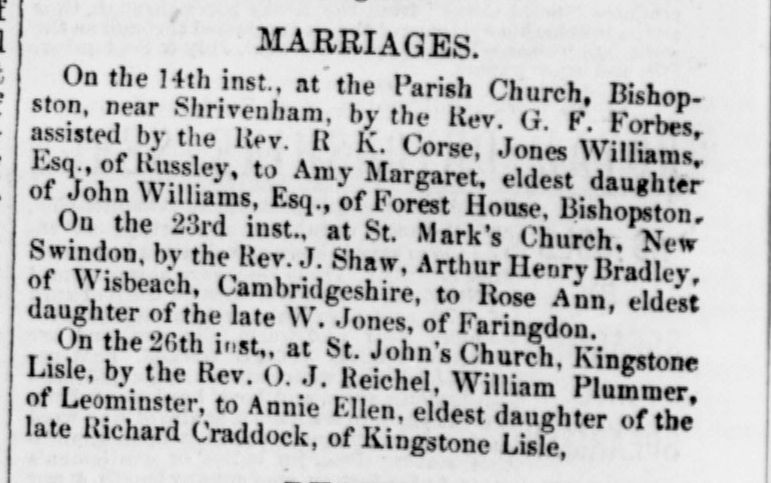
They returned to Ryburgh in September 1883 at the start of the new school year. In the interim they had been both in Shapwick in Somerset where their eldest child Florence was born on 8th October 1879 and as announced in the pages of the Faringdon Advertiser on 18th October 1879. He is reported to have improved the school during his time there:
Western Gazette - Friday 19 December 1879
SHAPWICK.
NATIONAL SCHOOL.—The following report as to the state of the above School, which was examined on Oct. 3lst by H.M. Inspector, Mr. R. Boyle, assisted by Mr.
Lucey, has been received:—" This school has certainly improved since last year; the cbildren show more intelligence in their answers, and are quieter in their order, and the general character of the school work bids fair soon to equal that of any school in the neighbourhood." The master's parchment has the following entry :—" Mr. Bradley has decidedly improved this school during the past year." The children were successful in needlework, grammar, and geography.
and in Atwick in Yorkshire, where Arthur George Osborne was born on September 23rd 1881.
Driffield Times 21st October 1882
ATWICK
HARVEST THANKSGIVING.—A harvest thanksgiving service was held in the Parish Church on Wednesday evening, when an excellent sermon was preached by the Rev. Elmet Brown, vicar of St. Jude's, Hull, from the text " Take no thought." The vicar, Rev. E. Jordan, read the prayers, and the lessons were read by the Rev. E. A. Tickell, vicar of Ulrome. Mr. A. H. Bradley officiated at the harmonium. There was a good attendance, and a collection was made in aid of the organ fund. The Church was nicely decorated.
Arthur writes in the school log book:
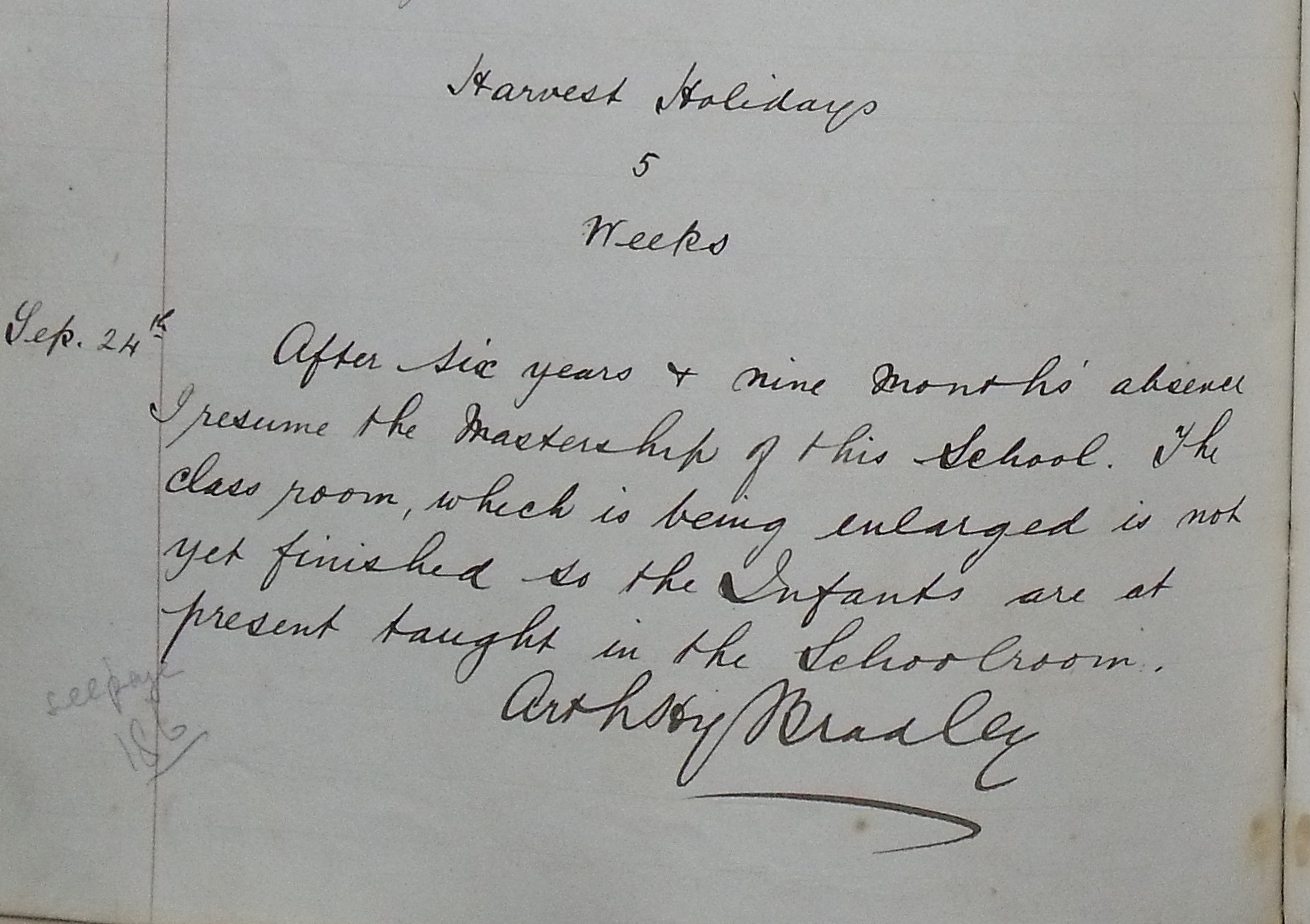
He also records the admission of his son Arthur to the school on September 29th 1884:

The staff of the school in 1888 are listed in the following image:
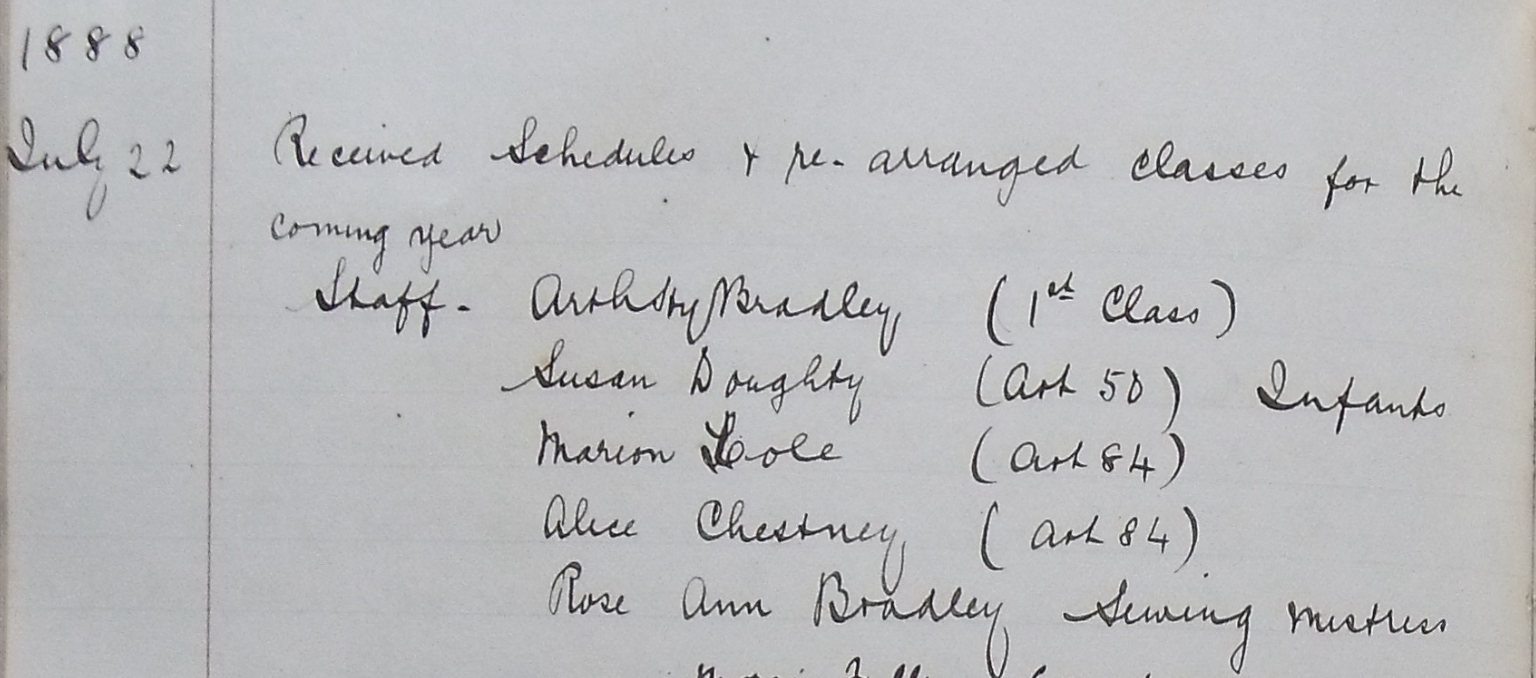
If the date of 1888 on the photo below is correct, then it is entirely possible that the bearded man on the extreme left of the top row is Arthur Henry Bradley himself. The central female figure with the child upon her knee could well be Mrs Rose Bradley and their youngest daughter Elizabeth Mary (born in Ryburgh on 31st May 1884) upon her knee. Another son William Victor was born in the 3rd quarter of 1887 and who subsequently died aged 5 in 1893.
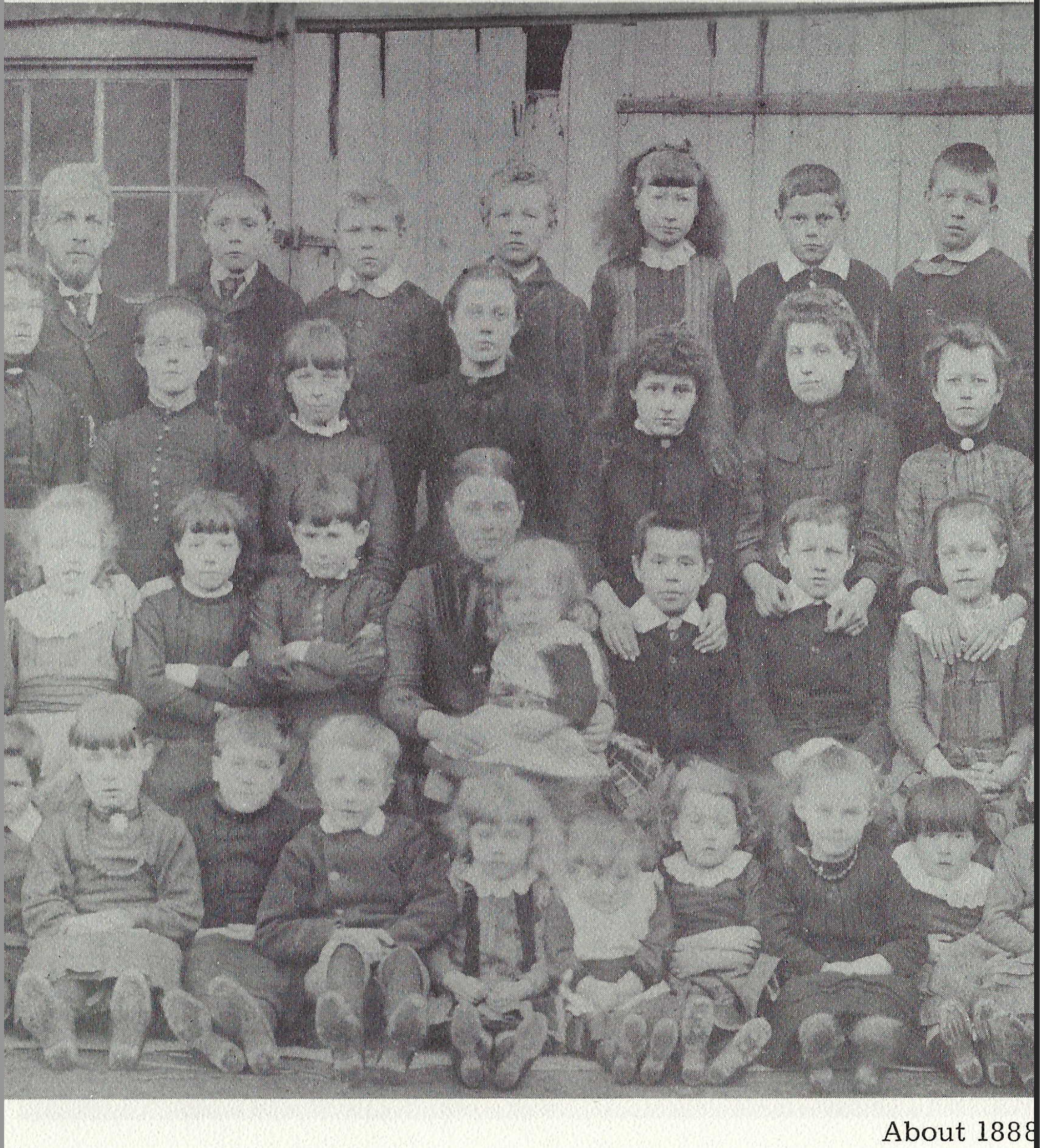
Further speculation might suggest that the boy to her left and the girl on the row above with her hands on his shoulders could also be family members, Florence Rose Bradley b 1879 and Arthur George Osborne Bradley born 1881…….but perhaps we should not get too carried away!:
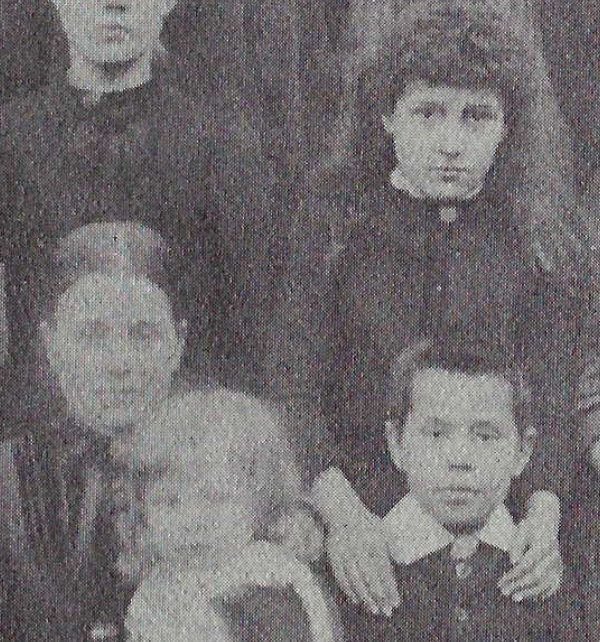
It is such a shame that the cropping by others has robbed us of an image of what might have been the earliest visual record of the complete staff and pupils of Ryburgh School.
During his second term as schoolmaster, he was inevitably involved in the general life of the village and church. Amongst other things, he was an ongoing treasurer or secretary of the cricket club, representative in the Vestry, a possibly unwilling intermediary in the unfortunate episode of the Ryburgh Scandal, and “the recipient of a handsome silver watch and chain, costing sixteen guineas, subscribed for by a few friends, and presented to him in recognition of his voluntary services in playing the organ and training the choir, and also to give practical expression to the feeling of general esteem in which be in held in the parish. Mrs.F. Smith kindly invited all the subscribers to the Mill House, when the presentation was made by Mr. H. E.Smith (churchwarden) in a few well-chosen remarks. The watch bore a suitable inscription. The intended presentation was kept secret, and the consequence was that up to the last moment Mr. Bradley was entirely ignorant of the pleasing testimonial he was about to receive.”......Norfolk News 27th April 1889
The Log book for this period shows he was (still) a rigorous enforcer of school discipline that sometimes seems to lapse in his absence nevertheless being swiftly put right on his return to duty!
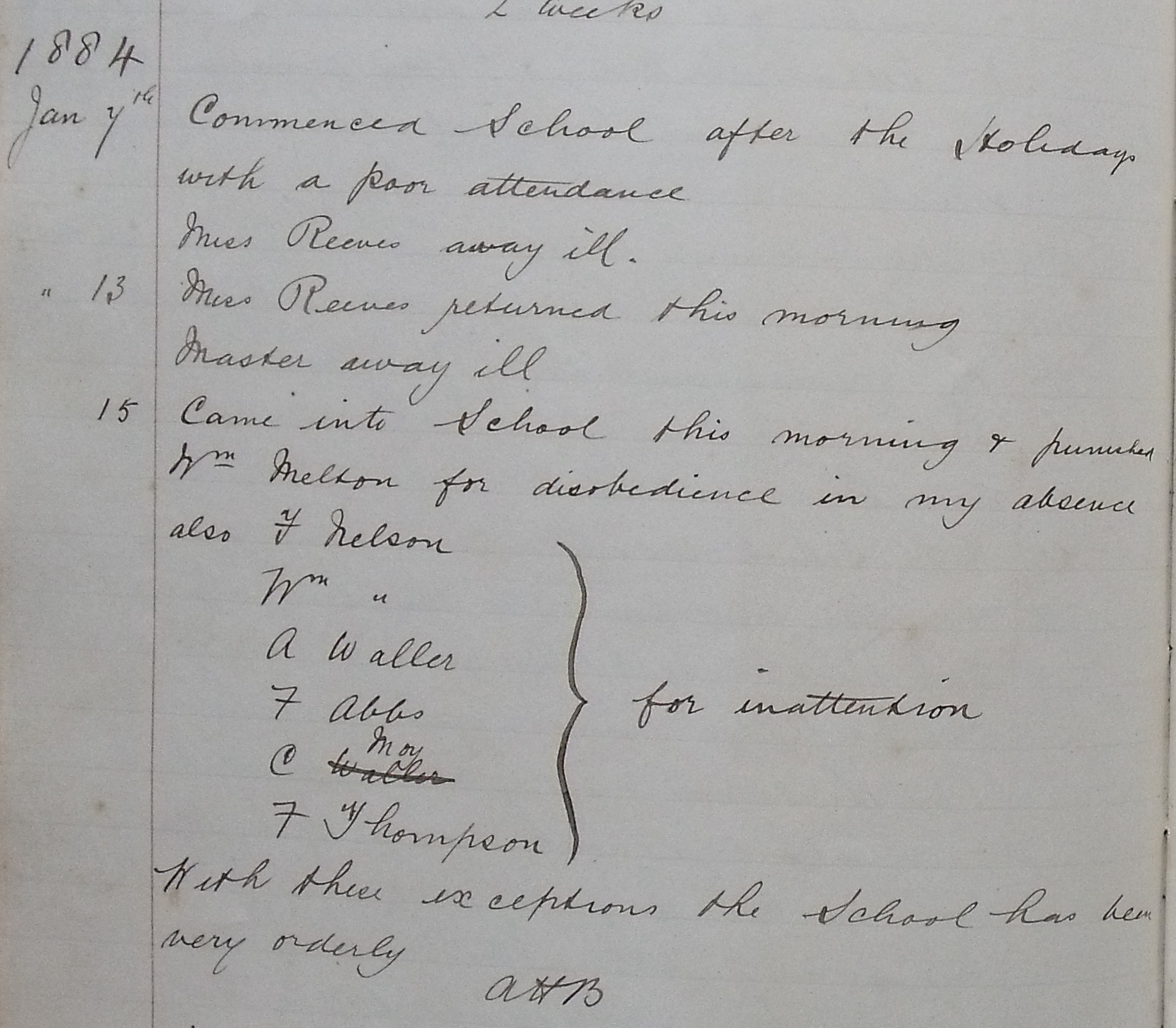
He also presided over the school at a time when illnesses spread quickly in school and not without consequence as seen here at the end of the 1885 school year:

Although not infrequently unwell himself, Arthur Bradley remained in post with some unspecified condition until 1st December 1890 and in January 1891 a temporary head was engaged due to his continued illness. He was however never able to resume his duties and he died on April 6th 1891 aged just 41. At this point Albert Foster, who had taken over on a temporary basis, was offered the post of Schoolmaster as a permanent position on July 24th 1891. Mrs Rose Bradley remained on the staff a further 20 years as a sewing mistress finally having to have her contract terminated in August 1910, along with Lena Smith, as being deemed not suitably qualified under changed Government education legislation.
We see Rose again in the Census returns for 1911 when her widowed mother Ann Jones is living with her and again in 1921 but this time living alone.
Daughters Florence Rose and Mary Elizabeth (as she seems to be known) both worked as governesses in the private households of various businessmen, teachers and clergymen. Florence must have returned home at some point after 1921 as she was buried in Ryburgh in February 1928, aged 48. Rose Ann Bradley died in March 1935 aged 85 and is also buried in Ryburgh. The last record we find of Mary Elizabeth is in the 1939 register at Elderton Lodge in Erpingham where she is still described as a governess.
*********
The Roll of Honour for Great and Little Ryburgh and Testerton lists A.G.Osborne Bradley: City of London Rifles.
It was not until the following appeared on the British Newspaper Archive pages that I started to discover a little more about him and his Ryburgh family:
Norfolk News for May 22nd 1915 has the following item in its pages which includes his photograph under the heading:
6000 MILES TO ENLIST
Private A. O. Bradley of Great Ryburgh, who recently returned 6000 miles from Buenos Ayres to join the Army He held a highly remunerative post, which he sacrificed, on the Andes Railway and booking his passage home on the Corinthian, he arrived safely in London Dock and joined the London Rifle Brigade. He in the only son of Mrs Bradley, widow of the late schoolmaster, and he is the sixty third old boy of the present schoolmaster to join the forces.
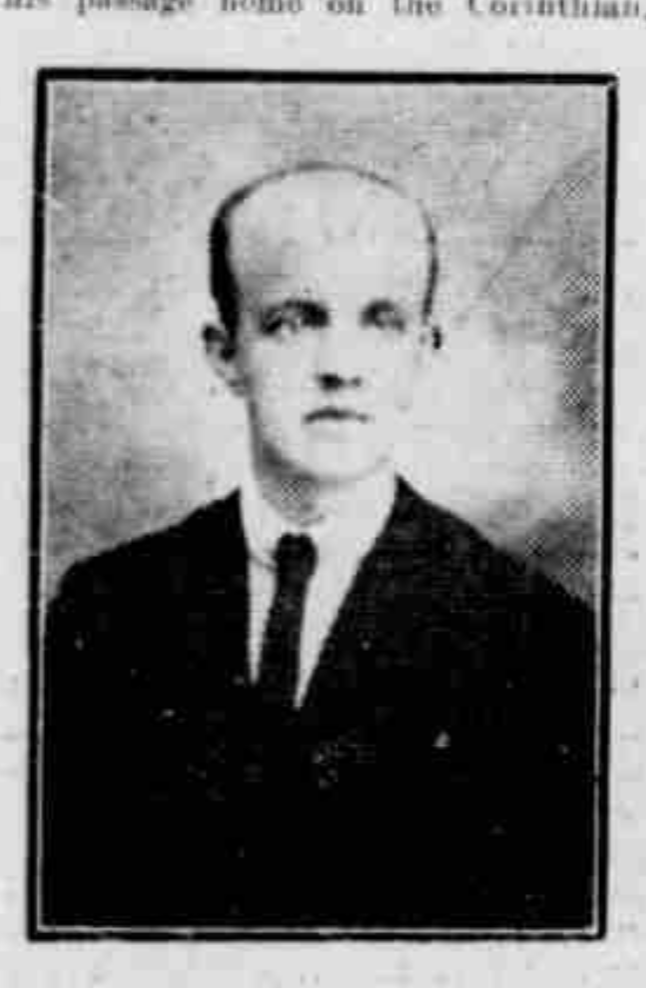
This explained why he was not that easy to find in the UK…...because he wasn’t here!
The school registers that survive post date the school days of all the Bradley children and so the Census returns are the best source of dated information. By 1901 A.G.O. as we shall call him, was lodging in Little Dunham with a railway porter and his wife and is described as “Railway Clerk”. It would seem that this occupation would be a major part, if not all of his working life. By investigating passenger lists we can find that he first left Southampton 18th March 1910 on board the “ARAGUAYA” operated by the Royal Mail Steam Packet Company bound for Buenos Aries. He travelled 2nd class along with 211 other passengers from first to third class status. It transpires from the press clipping above that he had been recruited to work on the Trans-Andean Railway that runs through Argentina to Chile across the Andes mountains.
On his return to the UK he wasted no time in enlisting on 11/5/1915 with the 1/6 Lond. R. He was then aged 33 years 8 months, signed up for 4 years and worked as “Clerk & Pay”. He was deemed to have a “Degree of Proficiency: Sat.” He went to France on 27/10/1915. and on 8/10/1916 he received a Gun Shot Wound to his leg and neck and was repatriated 3 days later on 11th October.
On May 8th. 1917 we read in Rector F.H.Tatham’s Preacher’s Book held in the Norfolk Record Office that:
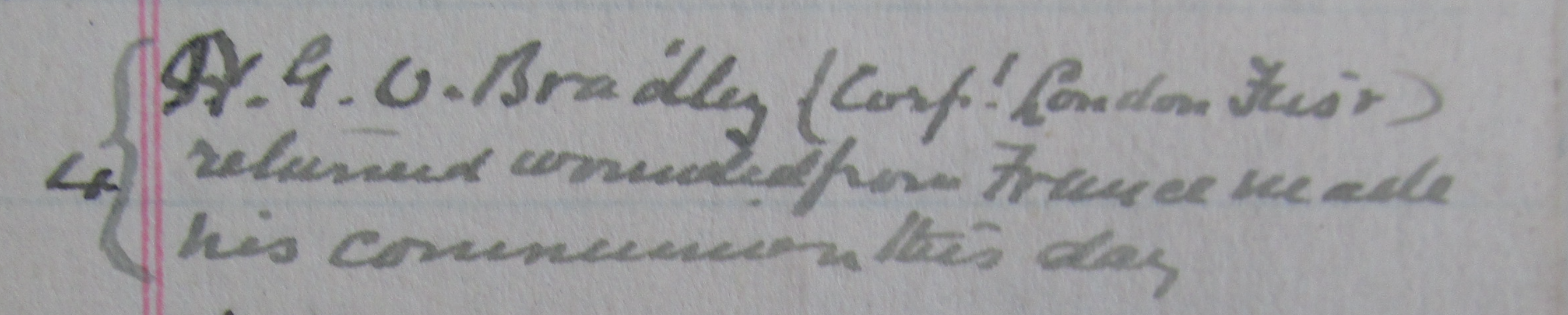
As a clerk, he was transferred first to the R.F.C. and then on to the RAF on its establisment. He was promoted to Corporal Clerk on 18/1/1919 shortly before his demobilisation although he had been "Acting Cpl." prior to that. He officially remained on the books until 21/10/1919. Thereafter he was transferred to the RAF Reserve until 30/4/1920. His Medal Index Card shows that he was awarded the 1915 Star, War and Victory Medals.
He married Phoebe Gertrude Woods at Stowmarket in Suffolk on March 31st 1918. She was the daughter of a Gorleston fisherman, William Henry Woods and Eleanor Moules though they had both died by the time of the wedding. She had 10 siblings and thus Gorleston, more so than Ryburgh, was their home when in England. Tragically their only child, a son William O.[Osborne?] Bradley, died at birth in the summer (probably June) of 1919
A note on one of his surviving Army records reads:
“Refund cost of passage from Monte Video on proceeding home for enlistment (what looks like a reference to a letter and the date 31/1/19) entitled to return passage to that place on demobilisation or discharge if he fulfills the other necessary conditions”
At the first opportunity the couple sailed to Monte Video leaving from Portishead (Bristol) on March 20th 1920, aboard the “Colonia.” His occupation is listed on the manifest as “Army” although it was clearly to continue his employment with the railway in Argentina.
They returned to Great Ryburgh on 9th June 1928, the year in which his sister Florence died and made the return journey on the 9th Ausgust 1928 having left the UK address: 10 Sussex Road Gorleston
Their next trip back to England was in 1933 between the 5th June and 26th August where the address is given as Gt.Ryburgh and this is probably the last time that he saw his mother.
They were back in England again in 1938 and must have returned to Argentina even though the sailing has not been found. They were back for good after the War in 1946 and back to 10 Sussex Road Gorleston. At the time of writing no details of their many years in Argentina have come to light.
They lived out their retirement in Gorleston ……..Phoebe died in 1971 and Arthur in 1973. With him, the 100 year old connection of the Bradley family and Ryburgh came to an end.
copyright 2025
and acknowledgement of the records of the British Newspaper Archive